
Read More of
The GET F.R.E.E. Report
Friday July 24th, 2026

WEEK 30
July 24th, 2026
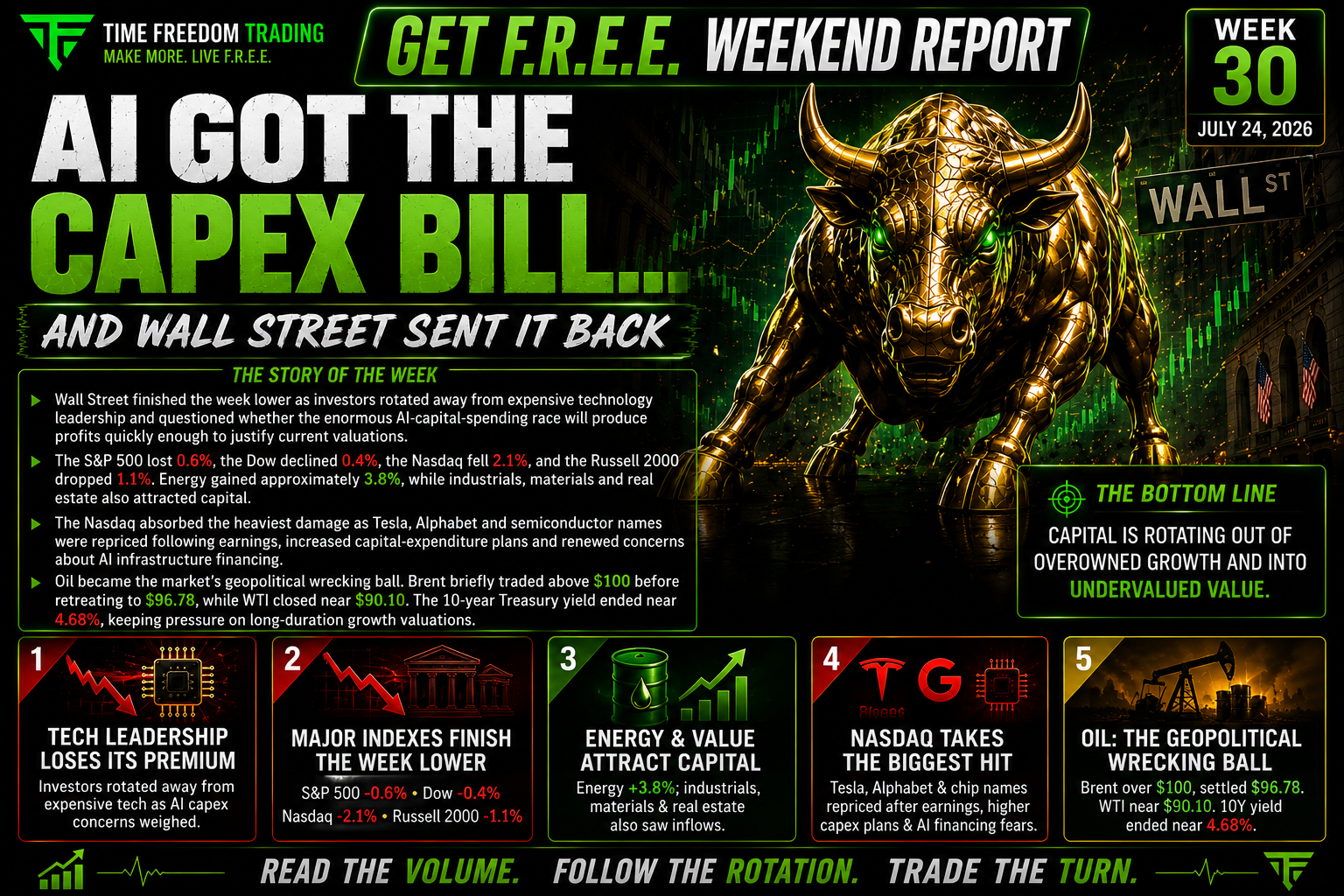
“AI GOT THE CAPEX BILL ...
AND WALL STREET SENT IT BACK"
Wall Street finished the week lower as investors rotated away from expensive technology leadership and questioned whether the enormous AI-capital-spending race will produce profits quickly enough to justify current valuations.
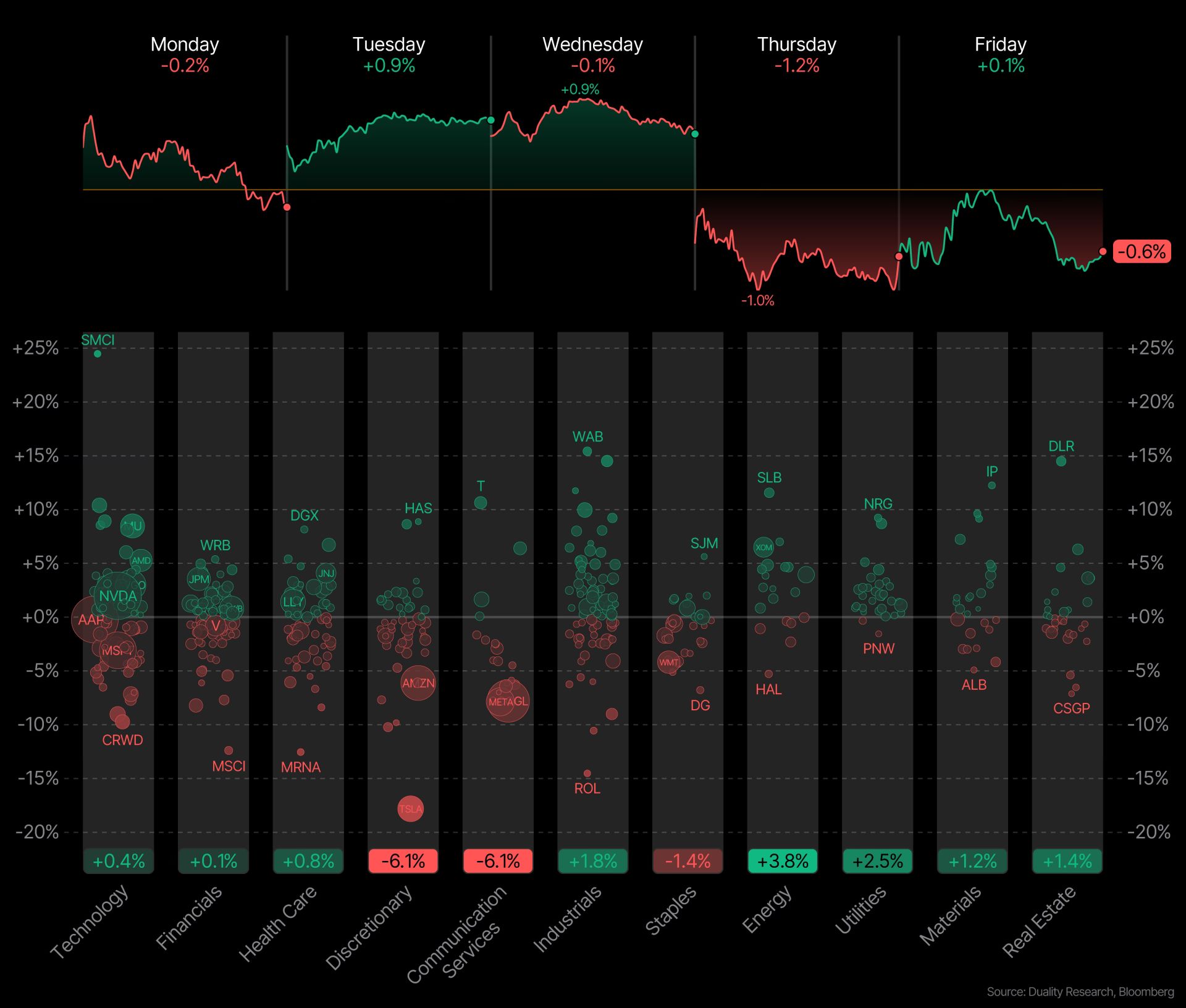
The S&P 500 lost 0.6%, the Dow declined 0.4%, the Nasdaq fell 2.1%, and the Russell 2000 dropped 1.1%. Energy gained approximately 3.8%, while industrials, materials and real estate also attracted capital. The
Nasdaq absorbed the heaviest damage as Tesla, Alphabet and semiconductor names were repriced following earnings, increased capital-expenditure plans and renewed concerns about AI infrastructure financing.
Oil became the market’s geopolitical wrecking ball. Brent briefly traded above $100 before retreating to $96.78, while WTI closed near $90.10. The 10-year Treasury yield ended near 4.68%, keeping pressure on long-duration growth valuations.
WEEKLY INDEX SCORECARD
| Instrument | Weekly Change | Close Price | Weekly Read |
|---|---|---|---|
| S&P 500 | -0.6% | 7,411.98 | Defensive rotation beneath the surface |
| Nasdaq Composite | -2.1% | 24,975.82 | AI and technology repricing |
| Dow Jones | -0.4% | 51,947.25 | Relative strength from value exposure |
| Russell 2000 | -1.1% | 2,930.00 | Small caps failed to escape risk-off pressure |
| SPY | — | $738.93 | Held near major support |
| QQQ | — | $684.23 | Technology remained the weak link |
| DIA | — | $518.76 | Outperformed QQQ |
| IWM | — | $291.17 | Weak but not disorderly |
| Bitcoin | — | $64,305 | Stable relative to equity volatility |
WEEKLY MARKET INTERNALS
Breadth remained uneven, Nasdaq participation weakened, and higher yields kept expensive growth stocks on a short leash. But capital did not disappear; it rotated.
That distinction matters.
A market correction says, “Sell everything.”
A rotation says, “Stop owning the wrong things.”
The Bald Bull takeaway: do not chase headlines, follow institutional money flow. Read the Volume. Follow the Rotation. Trade the Turn.
| Internal | Weekly Read | TFT Interpretation |
|---|---|---|
| Breadth | Mixed | The equal-weight market held up better than mega-cap technology |
| Advance/Decline | Weak on Nasdaq | Selling was concentrated in former leadership |
| Up/Down Volume | Negative in technology | Distribution appeared in AI, memory and high-beta growth |
| Relative Strength | Energy, real estate, industrials | Capital rotated rather than leaving the market completely |
| Volatility | Elevated but controlled | Fear increased without full liquidation |
| Treasury Yield | Near 4.68% | Higher discount rates pressured expensive growth stocks |
| Oil | Sharply higher for the week | Geopolitical inflation risk returned |
| Market Regime | Late-cycle rotational correction | Index weakness masked selective strength |
SECTOR ROTATION READ
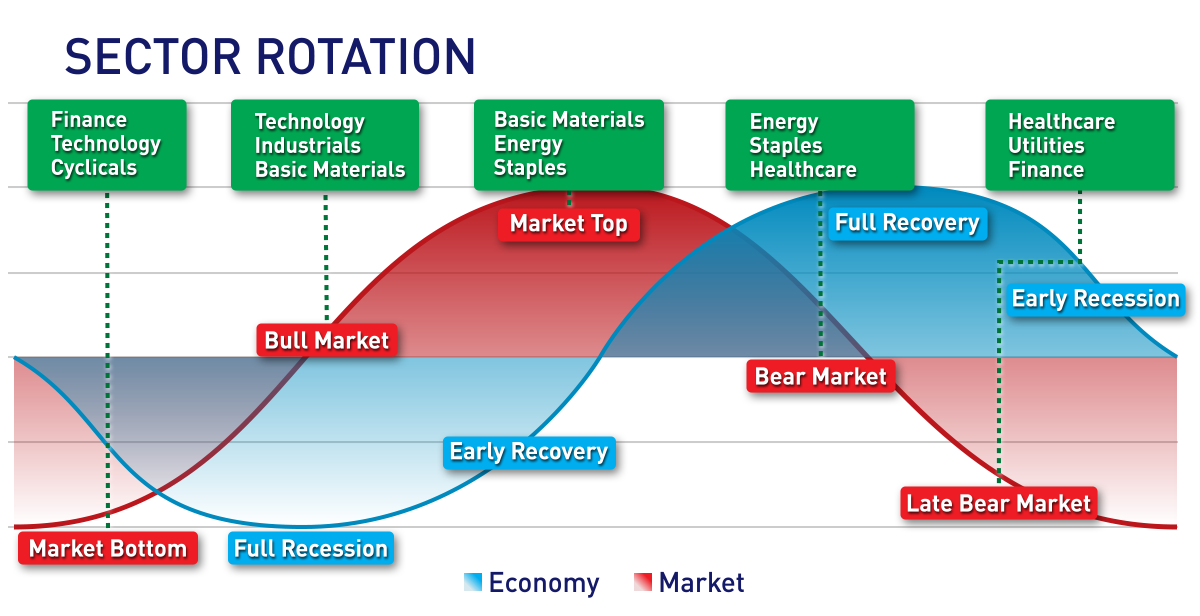
Late-Cycle Bull Market / Leadership Transition
This was not a universal market collapse. It was a transfer of capital from crowded AI leadership toward energy, real estate, industrials and other cash-flow-sensitive groups.
Weekly Earnings and Macro Recap
Alphabet posted strong operating results and rapid cloud growth, but investors focused on higher planned AI spending.
Tesla missed profit expectations and fell sharply after highlighting rising AI-infrastructure expenses.
Intel exceeded earnings expectations but dropped 7.9% Friday after raising its capital-spending outlook beyond $20 billion.
The week also produced strong reactions in SAP, Digital Realty, and Tenet Healthcare, while American Express and Oracle were punished for outlook concerns.
POSITIVE SECTORS
| Sector | Weekly Tone | TFT Read |
|---|---|---|
| Energy | Strong | Oil-price shock attracted momentum and inflation hedging |
| Real Estate | Positive | Digital infrastructure and falling Friday yields helped |
| Industrials | Positive | Rotation toward tangible-economy earnings |
| Materials | Positive | Inflation and commodity exposure gained relevance |
| Insurance | Constructive | Defensive earnings and pricing power attracted buyers |
NEGATIVE SECTORS
| Sector | Weekly Tone | TFT Read |
|---|---|---|
| Technology | Weak | AI-capex concerns overwhelmed strong revenue growth |
| Semiconductors | Distribution | Memory and chip leaders were aggressively repriced |
| Consumer Discretionary | Weak | Tesla earnings amplified valuation concerns |
| Communication Services | Mixed-to-weak | Alphabet’s spending plans overshadowed operating strength |
| High-Beta Growth | Risk-off | Expensive future cash flows met a 4.68% 10-year yield |
MARKET HEAT MAP - LIVE
WEEK 30 SUMMARY
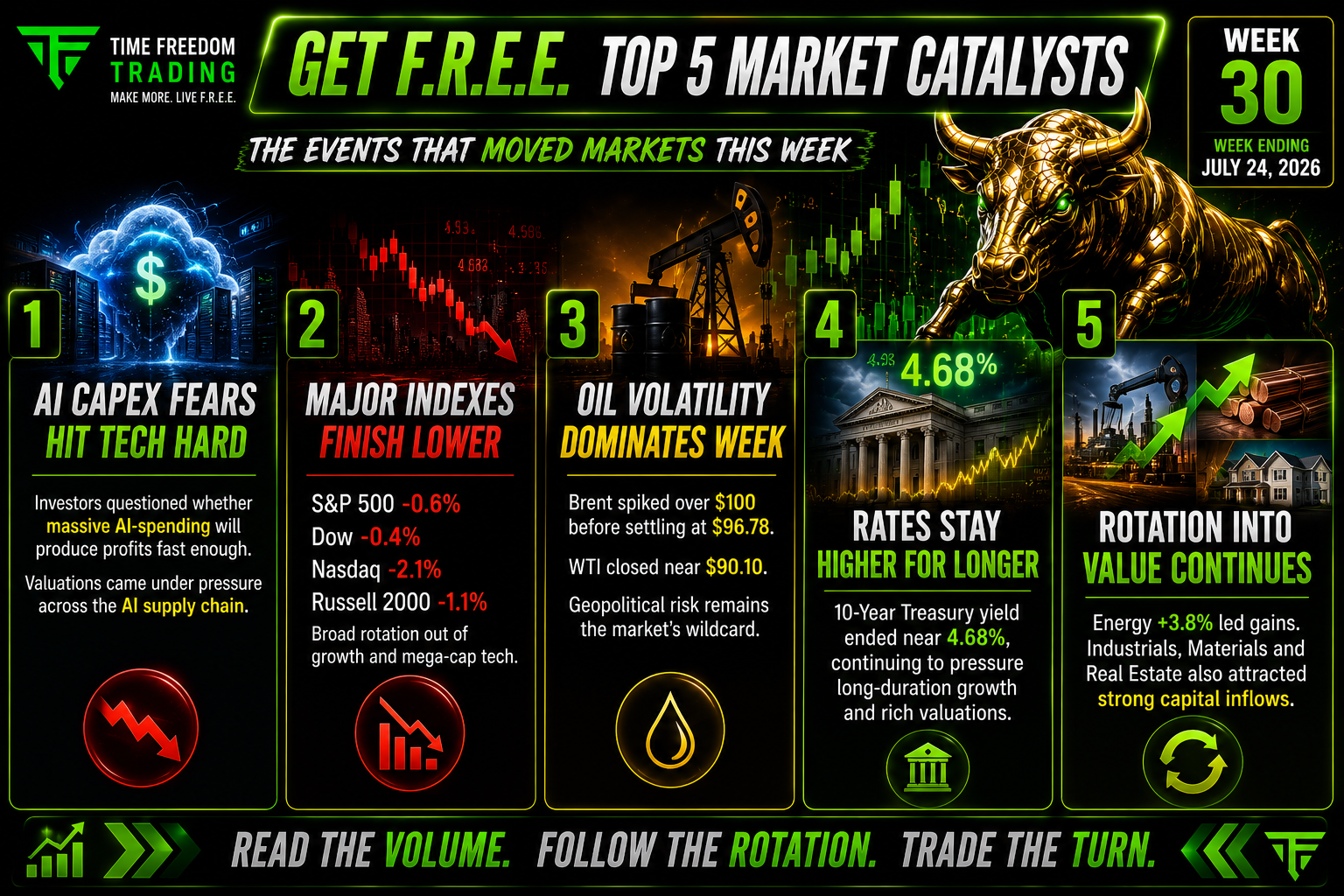
5 Key Catalysts That Moved The Week
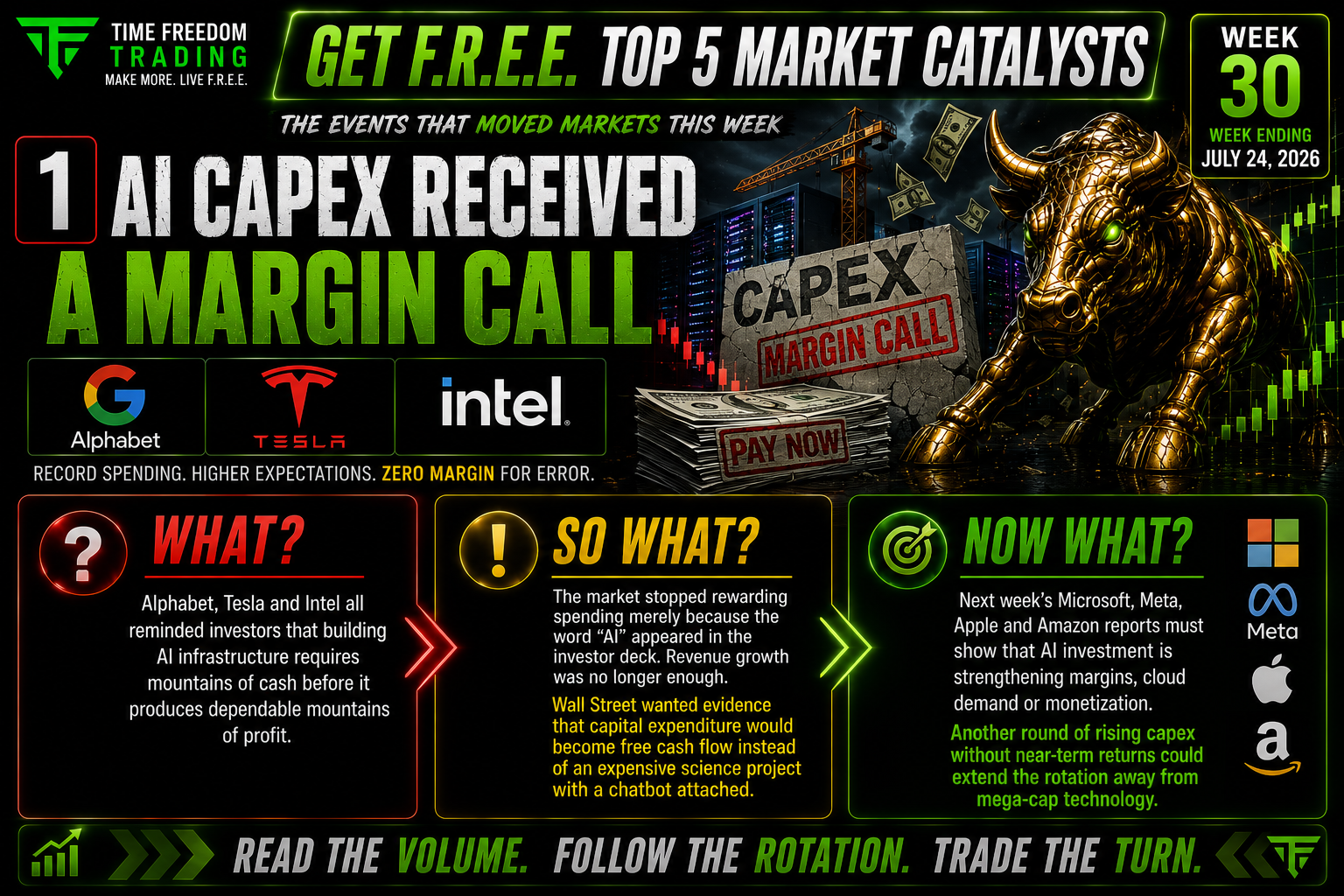
1. AI CAPEX RECEIVED A MARGIN CALL
WHAT?
Alphabet, Tesla and Intel all reminded investors that building AI infrastructure requires mountains of cash before it produces dependable mountains of profit.
SO WHAT?
The market stopped rewarding spending merely because the word “AI” appeared in the investor deck. Revenue growth was no longer enough. Wall Street wanted evidence that capital expenditure would become free cash flow instead of an expensive science project with a chatbot attached.
NOW WHAT?
Next week’s Microsoft, Meta, Apple and Amazon reports must show that AI investment is strengthening margins, cloud demand or monetization. Another round of rising capex without near-term returns could extend the rotation away from mega-cap technology.

2. TESLA’S EARNINGS DROP BROKE THE MOMENTUM SPELL
WHAT?
Tesla fell 12.6% Thursday after earnings and closed Friday at $313.03, down another -2.1% on the day.
SO WHAT?
The stock demonstrated that even the market’s favorite stories remain vulnerable when profits miss and spending rises. Narrative does not repeal arithmetic. It merely rents the penthouse until earnings sends the eviction notice.
NOW WHAT?
Watch whether Tesla can defend the post-earnings low. A failed bounce would confirm continued institutional distribution; a reclaim of the earnings gap would signal seller exhaustion.

3. OIL REINTRODUCED INFLATION RISK
WHAT?
Brent briefly crossed $100 amid Middle East tensions before retreating below $97 Friday.
SO WHAT?
Oil is both a commodity and a tax. Higher energy costs can lift inflation expectations, pressure consumers and reduce the Fed’s freedom to ease policy.
NOW WHAT?
A renewed move above $100 would favor energy while pressuring transports, discretionary stocks and rate-sensitive growth. A sustained retreat would remove one of the bears’ strongest macro weapons.
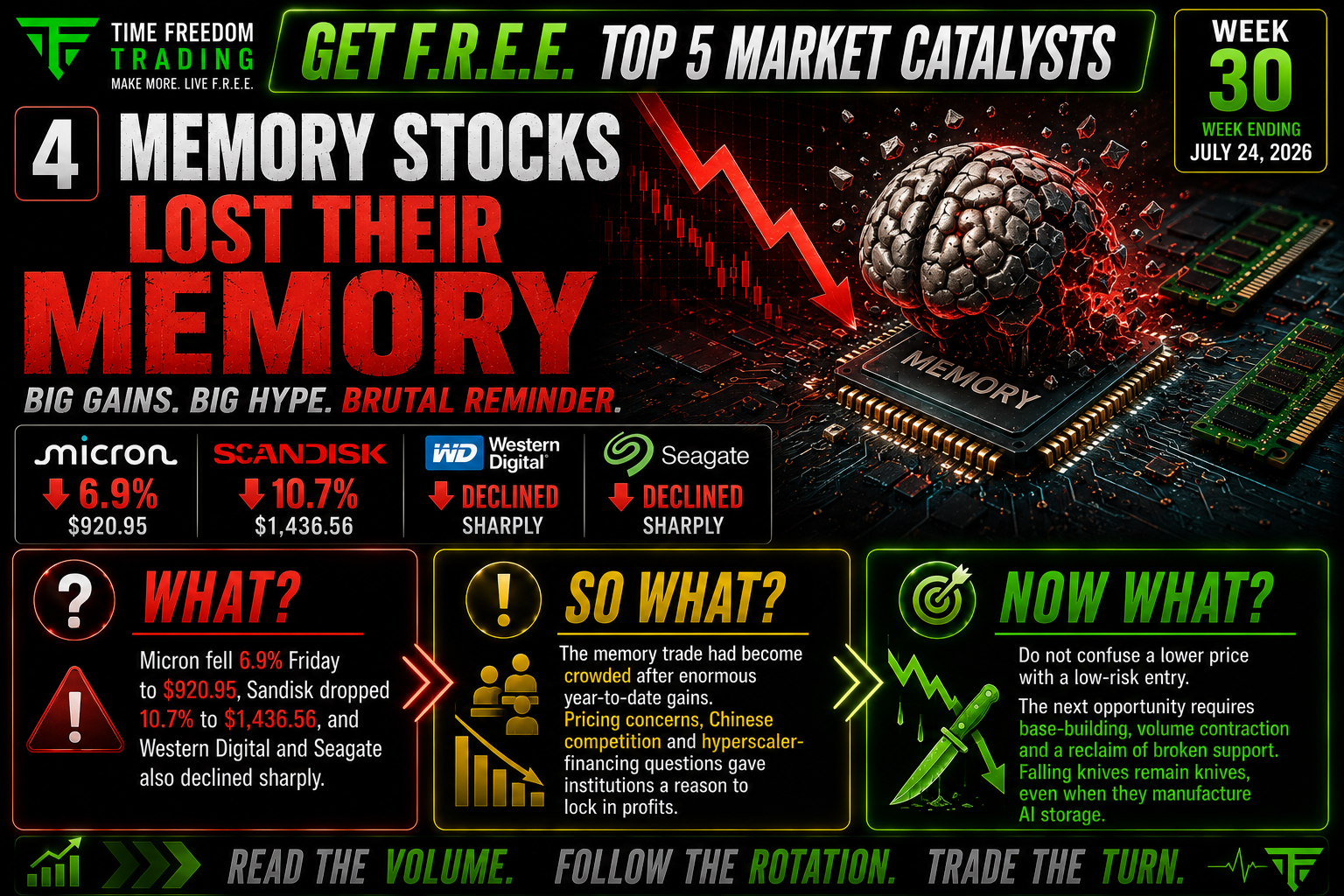
4. MEMORY STOCKS LOST THEIR MEMORY
WHAT?
Micron fell 6.9% Friday to $920.95, Sandisk dropped 10.7% to $1,436.56, and Western Digital and Seagate also declined sharply.
SO WHAT?
The memory trade had become crowded after enormous year-to-date gains. Pricing concerns, Chinese competition and hyperscaler-financing questions gave institutions a reason to lock in profits.
NOW WHAT?
Do not confuse a lower price with a low-risk entry. The next opportunity requires base-building, volume contraction and a reclaim of broken support. Falling knives remain knives, even when they manufacture AI storage.
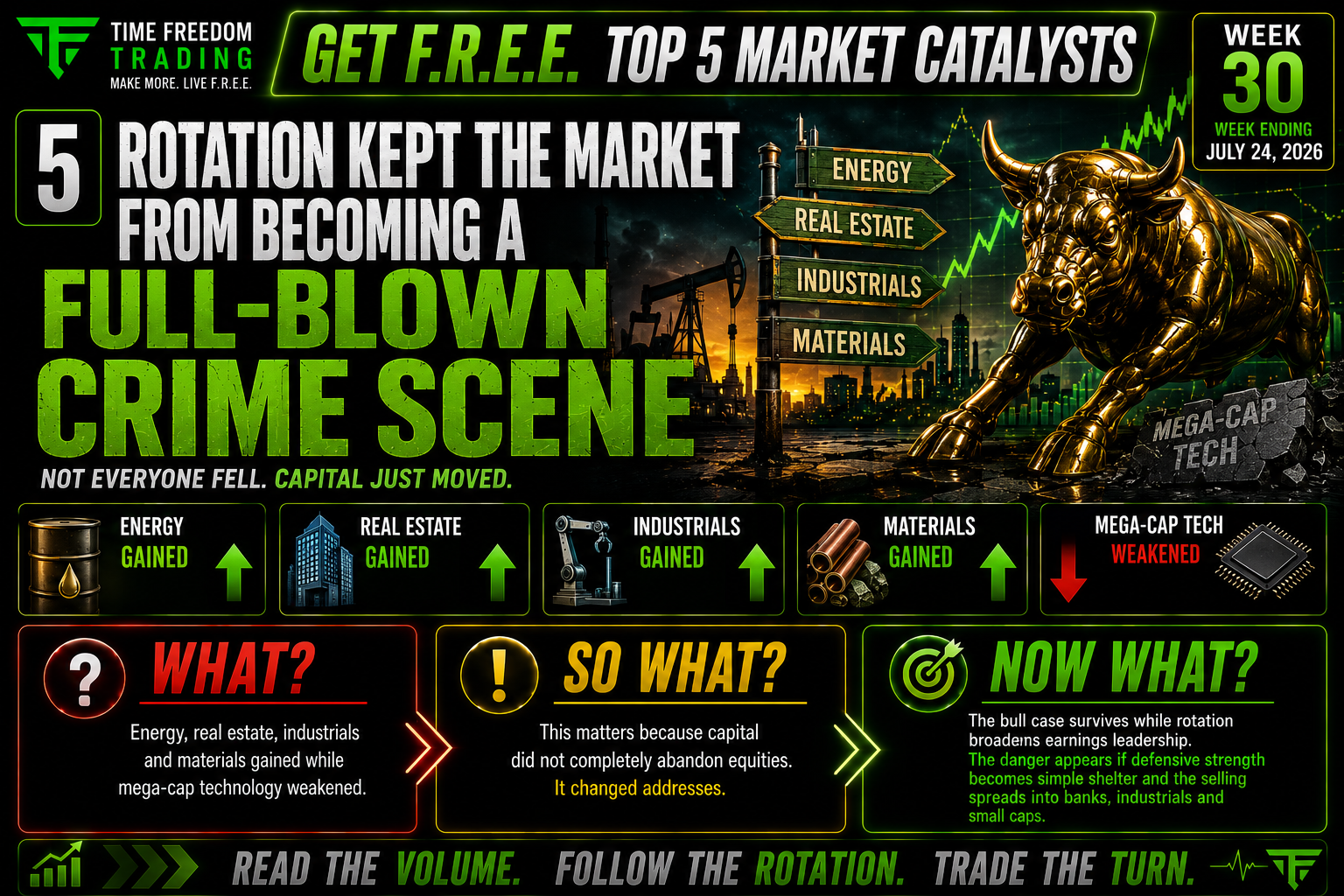
5. ROTATION KEPT THE MARKET FROM BECOMING A FULL-BLOWN CRIME SCENE
WHAT?
Energy, real estate, industrials and materials gained while mega-cap technology weakened.
SO WHAT?
This matters because capital did not completely abandon equities. It changed addresses.
NOW WHAT?
The bull case survives while rotation broadens earnings leadership. The danger appears if defensive strength becomes simple shelter and the selling spreads into banks, industrials and small caps.
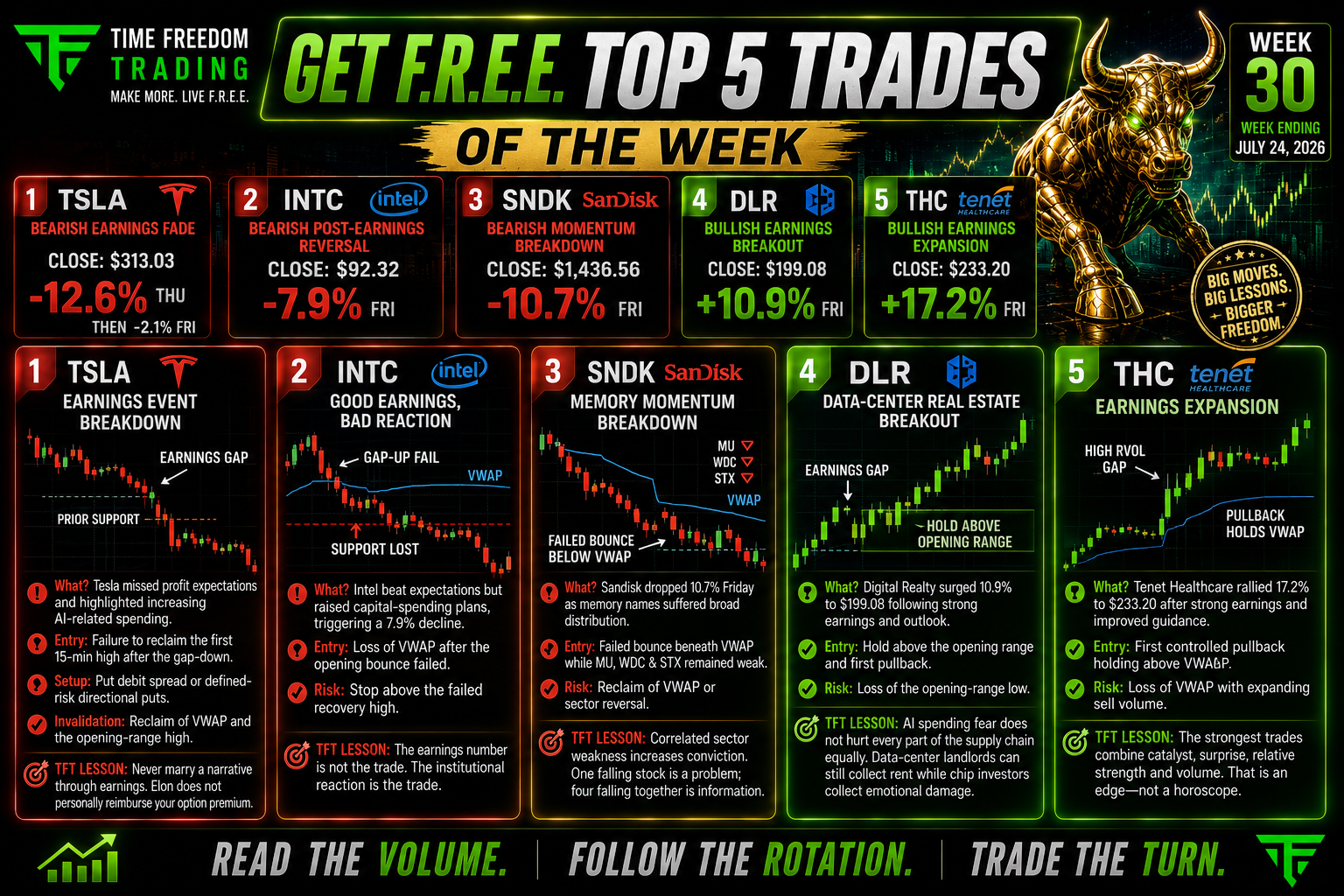
KEY TRADES OF THE WEEK:
NASDAQ TECH MOVERS
TOP 5 TRADES
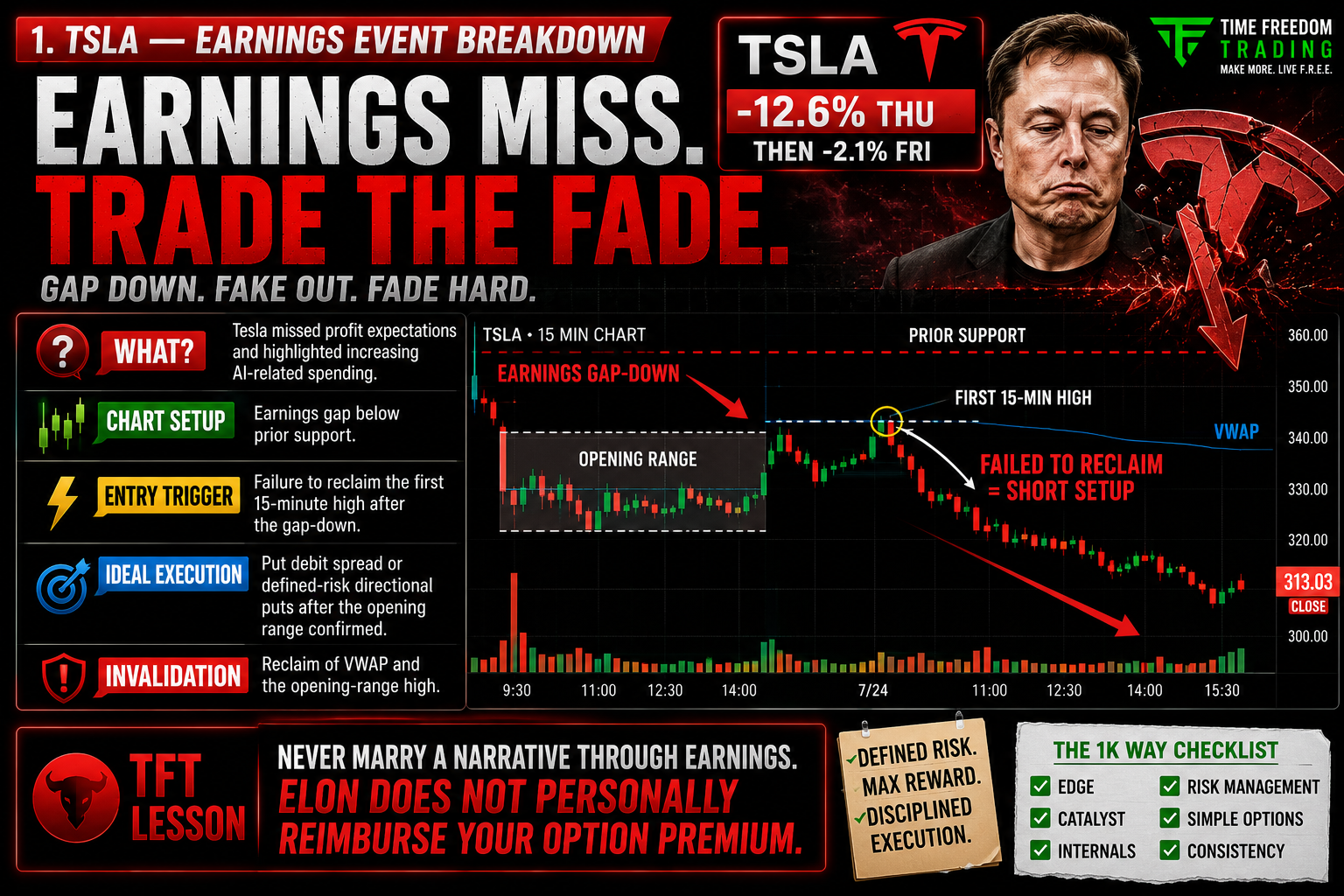
1. TSLA — Earnings Event Breakdown
What? Tesla missed profit expectations and highlighted increasing AI-related spending.
Chart setup: Earnings gap below prior support.
Entry trigger: Failure to reclaim the first 15-minute high after the gap-down.
Ideal execution: Put debit spread or defined-risk directional puts after the opening range confirmed.
Invalidation: Reclaim of VWAP and the opening-range high.
TFT lesson: Never marry a narrative through earnings. Elon does not personally reimburse your option premium.
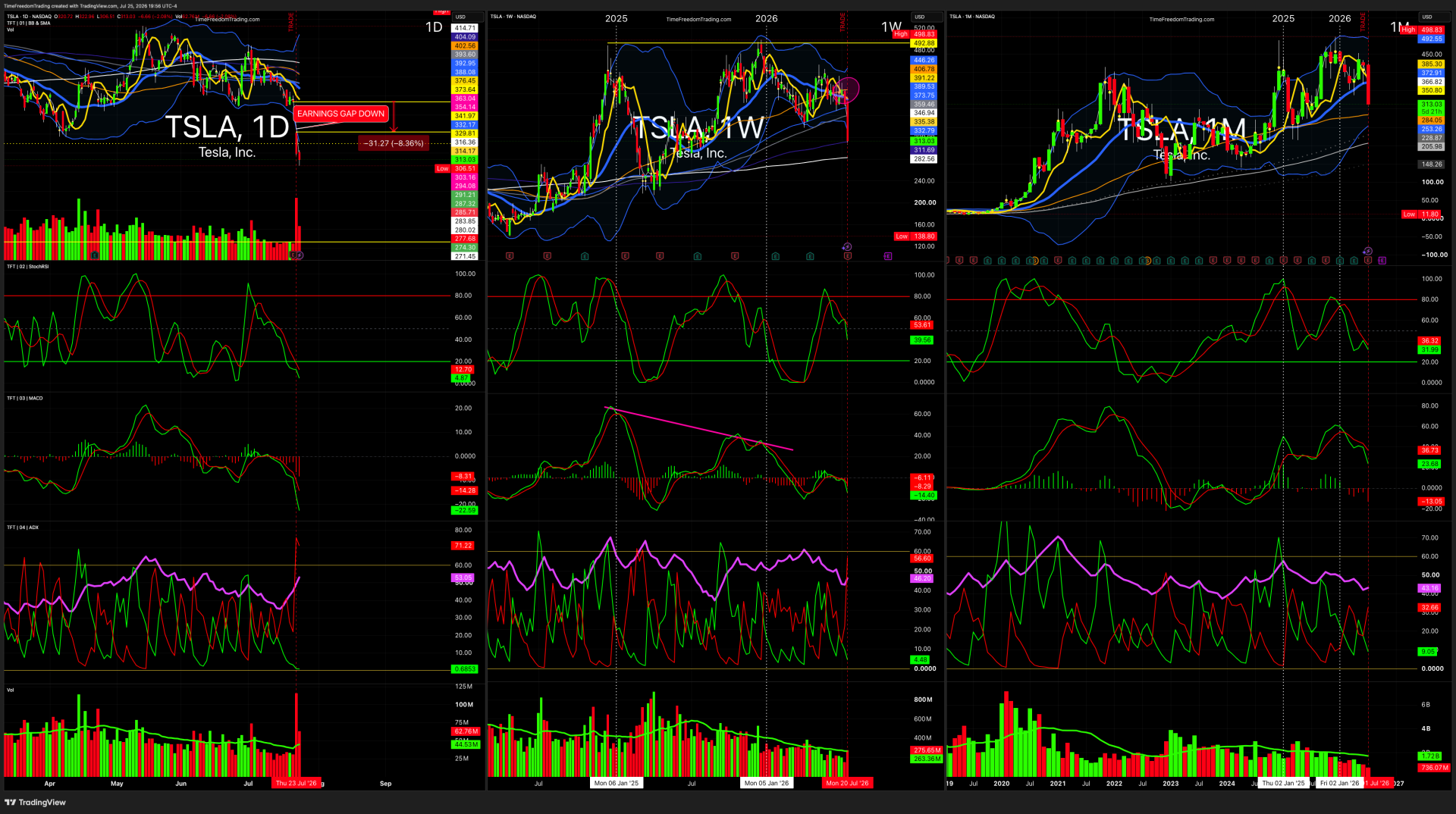
| Metric | Value |
|---|---|
| Direction | 🔴 Bearish |
| Friday Close | $313.03 |
| Thursday Earnings Move | -12.6% |
| Friday Follow-Through | -2.1% |
| Approx. Two-Day Move | -14.4% |
| Primary Catalyst | Earnings Miss + Rising AI Capital Spending |
| Trade Setup | Earnings Gap Below Prior Support |
| Ideal Entry | Failure to reclaim first 15-minute high |
| Confirmation | Loss of VWAP after opening-range failure |
| Ideal Strategy | Defined-Risk Long Puts |
| Invalidation | Reclaim of VWAP and Opening-Range High |
| Market Environment | Technology Distribution / AI Capex Repricing |
| Relative Volume (RVOL) | Elevated (institutional participation) |
| Institutional Read | Distribution |
| Trade Grade | ⭐⭐⭐⭐⭐ (A+) |
| 1K WAY™ Setup | Earnings Fade |
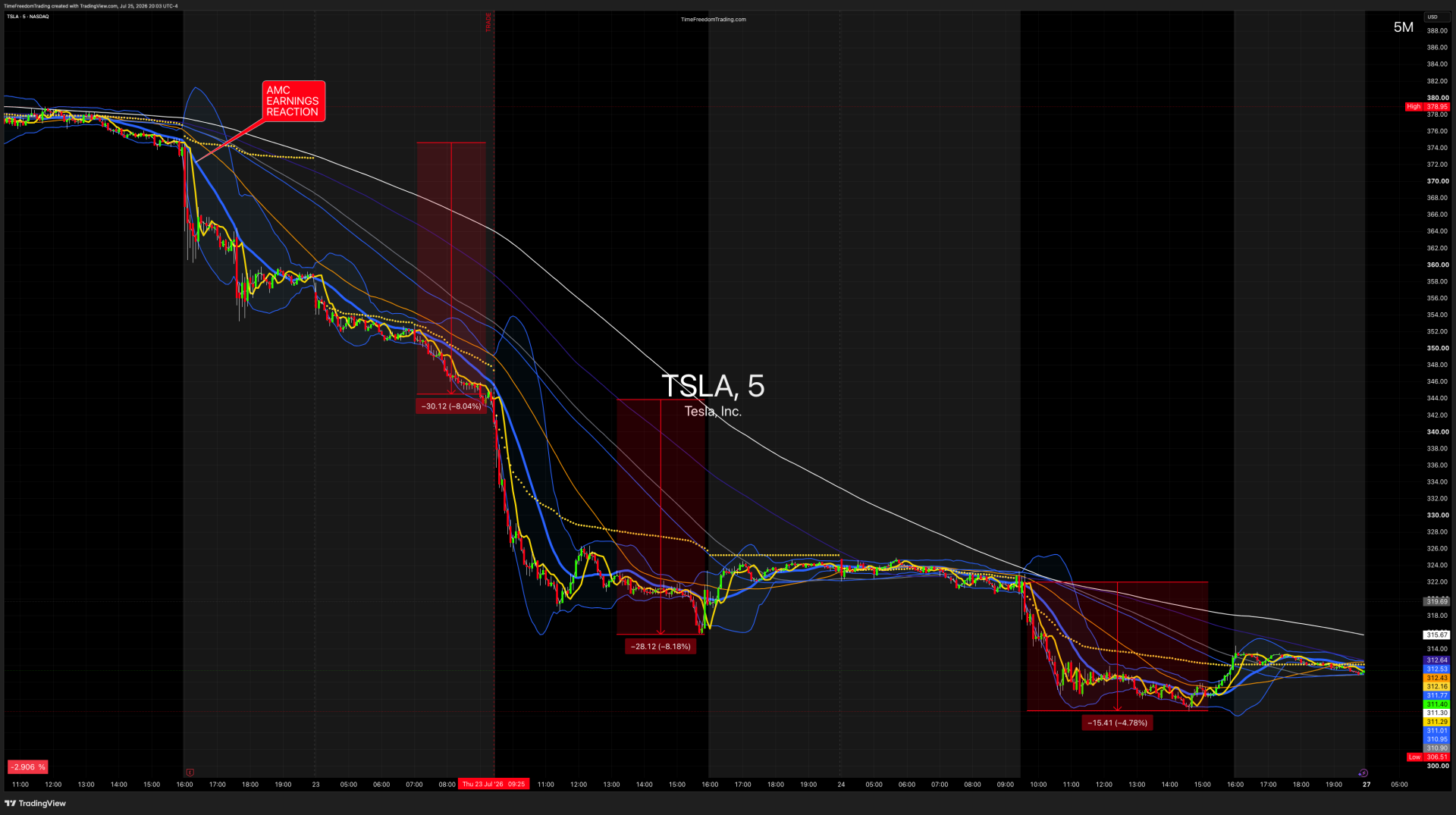
TSLA — Earnings Event FADE
The Trade That Reminded Wall Street That AI Still Has to Make Money
What Happened?
Tesla delivered one of the biggest earnings-driven selloffs of the summer after reporting weaker-than-expected quarterly profits while signaling that AI and autonomous-driving investments would continue to pressure near-term margins.
Although investors remain optimistic about Tesla's long-term AI ambitions, Wall Street focused on what matters today: earnings, free cash flow, and return on capital.
The market's response was swift.
Tesla plunged 12.6% on Thursday immediately following earnings before extending the decline another 2.1% on Friday, finishing the week at $313.03. The two-day decline erased weeks of upside momentum and became one of the most significant post-earnings reactions among the Magnificent Seven this quarter.
Catalyst
This wasn't simply an earnings miss.
Tesla reminded investors that building the future is expensive.
Management reaffirmed aggressive investment in AI infrastructure, Full Self-Driving development, robotics, and manufacturing capacity—all initiatives that require billions of dollars before they produce meaningful profits.
Wall Street shifted its attention from future potential to present-day profitability.
The market realized that AI isn't free.
It requires enormous capital expenditures before shareholders see meaningful returns.
Tesla became one of the first mega-cap companies to experience the market's new reality:
AI spending alone is no longer enough. Investors now demand evidence that those investments will translate into future cash flow.
Chart Pattern / Setup
Earnings Gap Breakdown
Tesla produced a textbook institutional earnings fade.
The stock gapped sharply lower following the earnings announcement and attempted an early recovery during Thursday's opening session. Buyers briefly stepped in, but the rally failed to reclaim the first 15-minute high and VWAP, confirming institutions were selling into strength rather than accumulating shares.
Once VWAP was rejected, momentum accelerated lower throughout the session, with additional follow-through selling into Friday confirming that large funds were reducing exposure rather than buying the dip.
This was not emotional retail selling.
It was professional distribution.
Art of the Chart
One earnings announcement erased weeks of bullish momentum.
The combination of a large earnings gap, elevated trading volume, repeated VWAP rejection, and lower highs created a classic institutional distribution pattern.
Professional traders recognize that the first move after earnings is rarely the opportunity.
The opportunity comes when the market reveals whether institutions are using early rallies to accumulate—or to exit.
Tesla never reclaimed the opening range.
That failure became the trade.
TFT Read
Tesla wasn't punished because investors suddenly stopped believing in electric vehicles.
Nor was it punished because AI is dead.
Tesla was repriced because Wall Street has entered a new phase of the AI cycle.
For the past two years, simply announcing larger AI investments pushed valuations higher.
Today, investors want proof that those billions of dollars will eventually generate higher margins, stronger free cash flow, and accelerating earnings growth.
Capital is becoming more selective.
The market is no longer rewarding every AI story equally.
It is beginning to reward companies that can convert AI spending into shareholder returns.
That distinction will likely define the next phase of this bull market.
TFT Lesson
Never chase an earnings gap.
And never average down simply because a great company becomes cheaper overnight.
Instead, wait for the market to prove that institutional selling has ended.
Look for:
Selling volume to begin contracting
Price stabilization near support
Higher lows on the daily chart
A successful reclaim of VWAP or the earnings gap
Confirmation that institutions are accumulating shares again
Remember:
Great companies can become terrible trades during earnings season.
Professional traders don't predict bottoms.
They wait for evidence that the bottom has already begun to form.
Watch Next Week
Watch five key developments:
Can Tesla defend the post-earnings low near $313?
Does daily trading volume begin to normalize after institutional selling?
Can buyers reclaim the earnings gap and VWAP?
Does the stock begin building a higher-low base instead of making lower lows?
Will upcoming Microsoft, Meta, Apple, and Amazon earnings reinforce—or reverse—the market's concerns over AI capital spending?
If those conditions develop, Tesla could transition from an earnings breakdown into a high-probability TURN™ recovery setup.
Until then, respect the trend.
Read the Volume. Follow the Rotation. Trade the Turn.
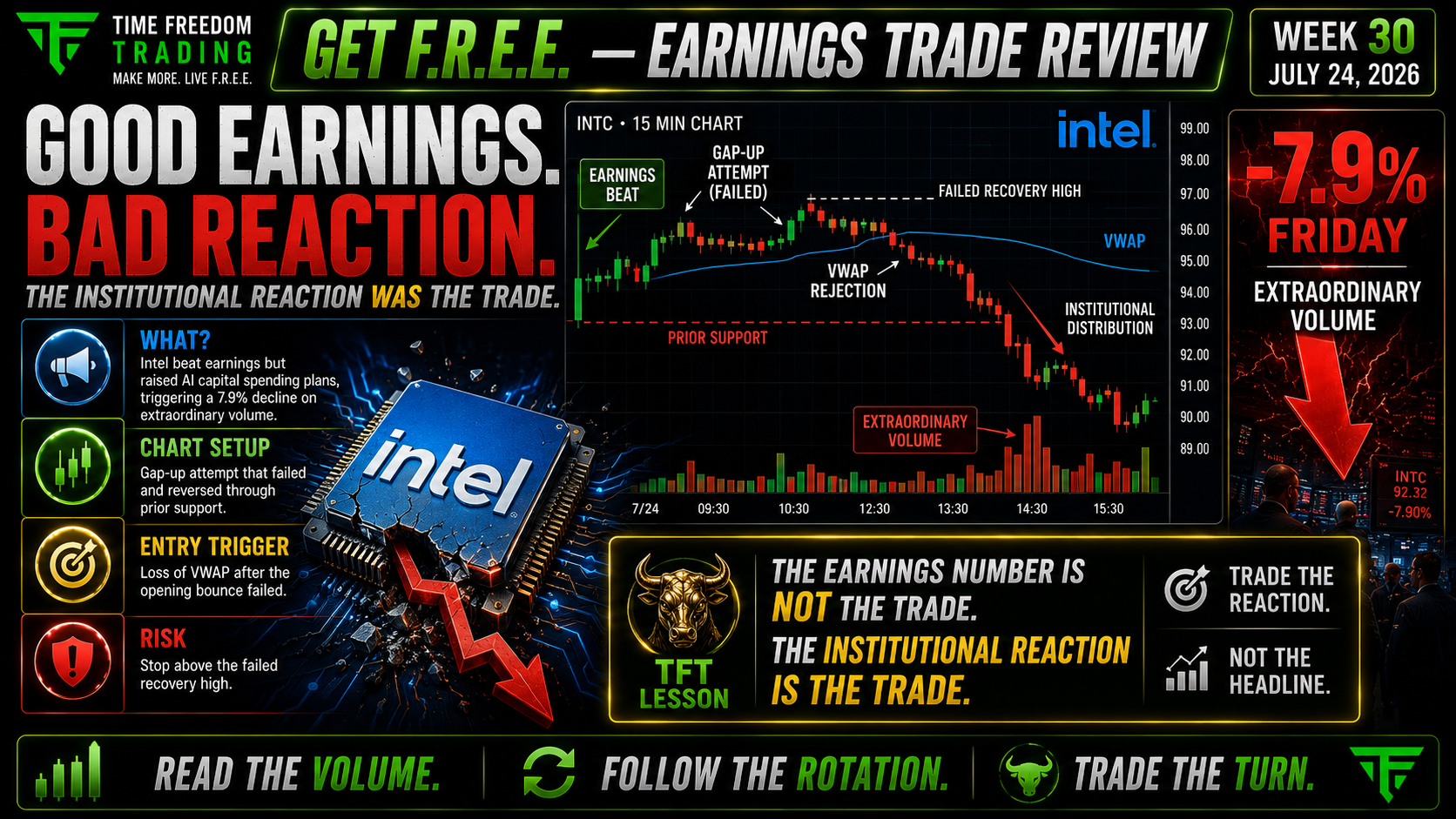
2. INTC — Good Earnings, Bad Reaction
The Trade That Proved Earnings Don't Move Stocks… Institutions Do
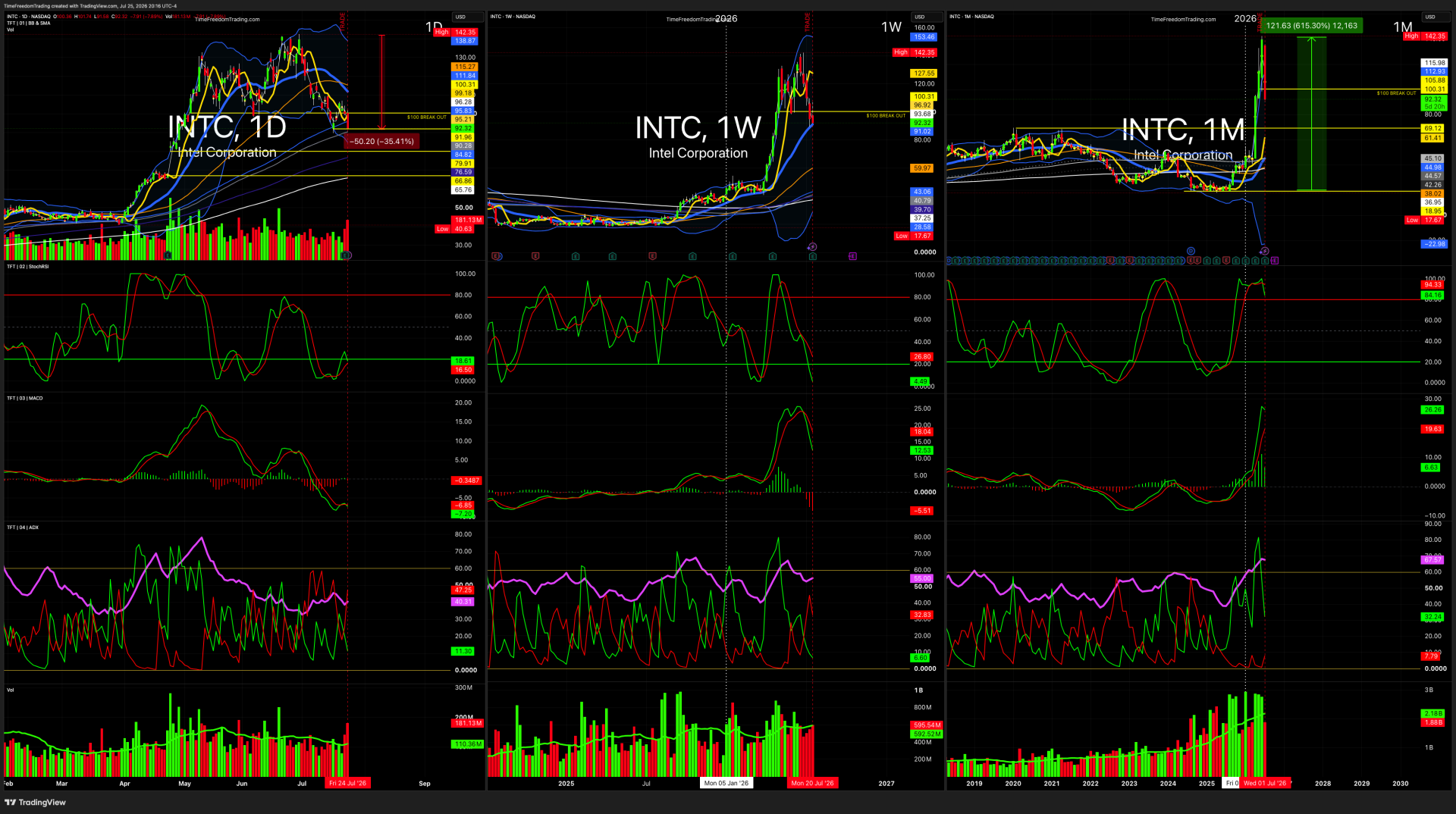
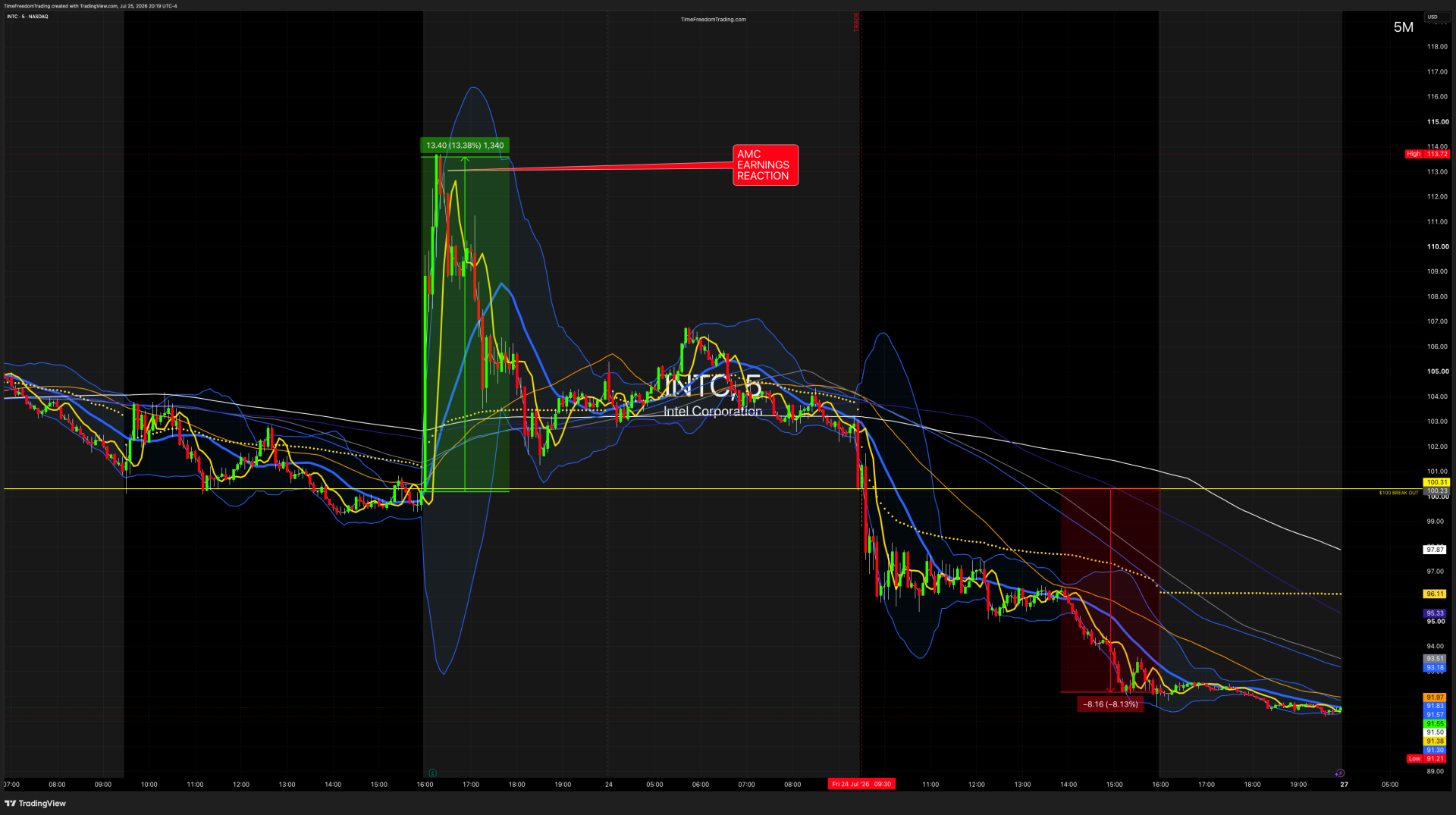
What? Intel beat expectations but raised capital-spending plans, triggering a 7.9% decline on extraordinary volume.
Chart setup: Gap-up attempt that failed and reversed through prior support.
Entry trigger: Loss of VWAP after the opening bounce failed.
Risk: Stop above the failed recovery high.
TFT lesson: The earnings number is not the trade. The institutional reaction is the trade.
| Metric | Value |
|---|---|
| Direction | 🔴 Bearish |
| Friday Close | $92.32 |
| Friday Move | -7.9% |
| Primary Catalyst | Strong Earnings + Higher AI Capital Spending |
| Trade Setup | Failed Gap-Up Reversal |
| Chart Pattern | Gap-Up Failure → VWAP Rejection → Breakdown |
| Entry Trigger | Loss of VWAP after opening bounce failed |
| Confirmation | Breakdown through prior support on heavy volume |
| Ideal Strategy | Put Debit Spread or Defined-Risk Long Puts |
| Risk / Invalidation | Stop above failed recovery high |
| Relative Volume (RVOL) | Exceptionally High (Institutional Participation) |
| Institutional Read | Distribution |
| Market Theme | AI CapEx Repricing |
| Trade Grade | ⭐⭐⭐⭐⭐ (A+) |
| 1K WAY™ Setup | Earnings Whipsaw Fade |
What Happened?
Intel reported quarterly earnings that exceeded Wall Street expectations, but investors focused on something far more important than the headline numbers.
Management announced significantly higher capital expenditures to accelerate its AI manufacturing roadmap, expand foundry capacity, and remain competitive in the race to supply next-generation AI chips.
Instead of celebrating the earnings beat, Wall Street immediately questioned the size of those investments and how long it would take before they generated meaningful returns.
The result was a classic institutional reversal.
Intel initially traded higher following the earnings release before sellers overwhelmed buyers, sending the stock down 7.9% on Friday to $92.32 on extraordinary volume.
Catalyst
This wasn't an earnings disappointment.
It was an investment disappointment.
Intel essentially told investors:
"We're going to spend significantly more money today so we can compete in AI tomorrow."
Wall Street had a different question:
"When does that spending become free cash flow?"
The market has entered a new phase of the AI cycle where capital expenditures alone are no longer enough to justify premium valuations.
Investors now demand evidence that billions of dollars invested today will eventually translate into higher margins, stronger earnings, and accelerating cash flow.
Chart Pattern / Setup
Failed Gap-Up Reversal
Intel produced one of the cleanest institutional reversal patterns of earnings season.
The stock initially gapped higher following the earnings release as traders reacted to the earnings beat.
That optimism lasted only briefly.
The opening rally stalled beneath the recovery high before price rolled back through VWAP and eventually broke prior intraday support.
Once VWAP failed, sellers remained in complete control for the remainder of the session.
The failed breakout became the trade.
Art of the Chart
Good news produced bad price action.
That is one of the strongest institutional signals a trader can receive.
When a company beats earnings yet cannot hold gains—and instead finishes near the session lows on exceptionally high volume—it often reflects institutional selling rather than retail emotion.
The market had already priced in the good news.
What it had not priced in was the scale of Intel's future spending commitments.
Professionals don't trade headlines.
They trade how institutions react to those headlines.
TFT Read
Intel wasn't punished because it reported poor earnings.
Intel was repriced because the market questioned how efficiently management would convert massive AI investments into shareholder returns.
This trade reinforced one of the biggest lessons of Week 30:
Capital is becoming increasingly selective.
The market is beginning to distinguish between:
- Companies spending billions on AI...
- And companies earning billions from AI.
That subtle difference is driving institutional rotation across the technology sector.
TFT Lesson
Never confuse a good earnings report with a good trade.
The trade begins after the market reveals how institutions interpret the news.
Instead, wait for:
- A failed opening breakout
- VWAP rejection
- Breakdown through prior support
- Expanding volume confirming institutional selling
-
Momentum continuation beneath the opening range
Remember:
The earnings number is not the trade.
The institutional reaction is the trade
Watch Next Week
Watch five key developments:
- Can Intel reclaim VWAP after the earnings breakdown?
- Does daily trading volume begin to normalize?
- Can price recover the failed gap-up area?
- Does AI capex sentiment improve after Microsoft, Meta, Apple, and Amazon report?
- Can Intel build a higher-low base above $92 before buyers return?
If those conditions develop, Intel could transition from an institutional earnings fade into a high-probability TURN™ recovery candidate.
Until then, let institutions finish distributing shares before attempting to catch the bottom.
🐂 The Bald Bull Takeaway
Good earnings don't guarantee higher prices.
Institutions vote with capital—not headlines. The smartest traders don't predict how earnings should be received; they observe how the market actually responds. When good news can't lift a stock, pay attention. That often tells you more than the earnings report itself.
Read the Volume. Follow the Rotation. Trade the Turn.
3. SNDK — Memory Momentum Breakdown
The Trade That Confirmed the AI Supply Chain Was Taking Profits
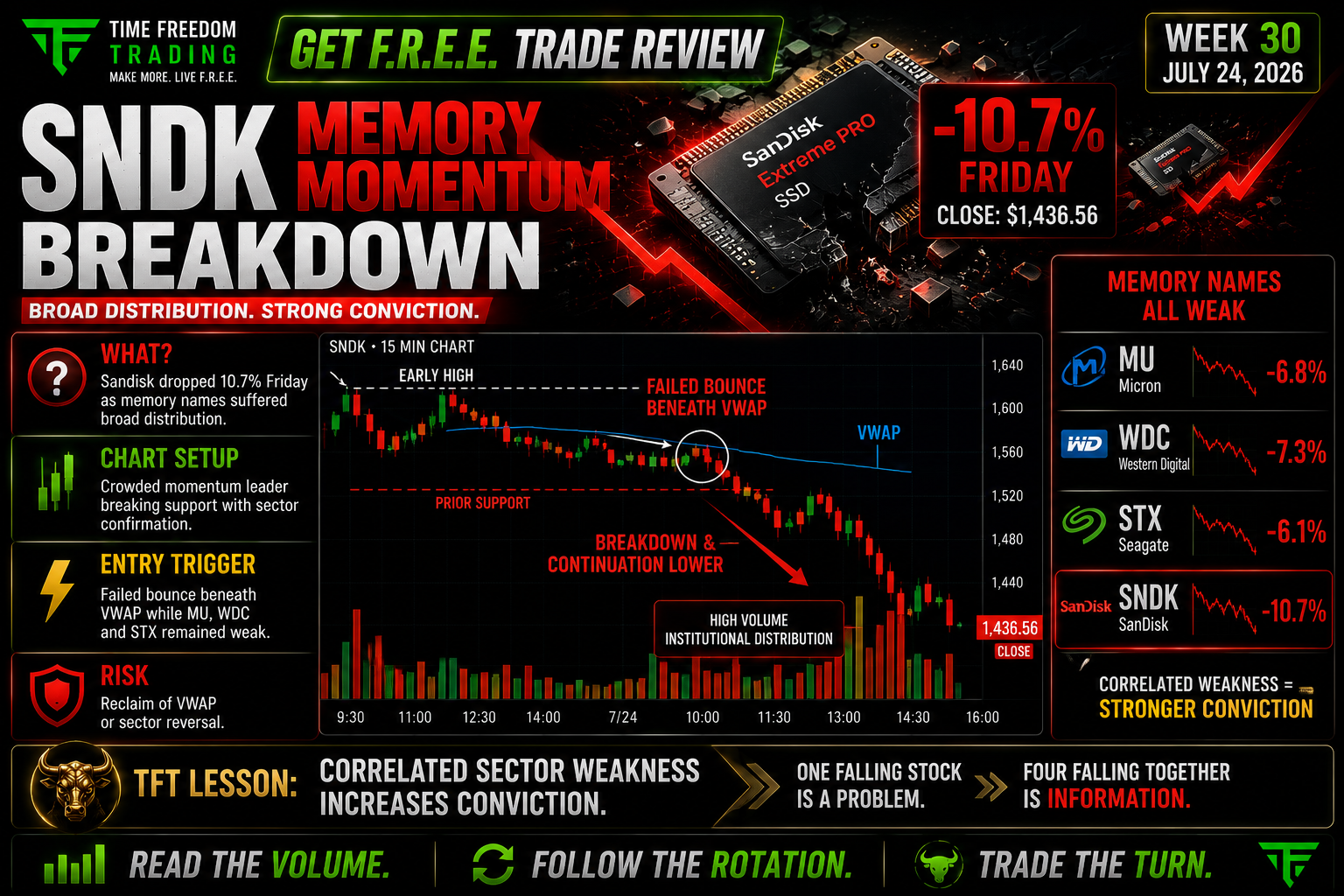
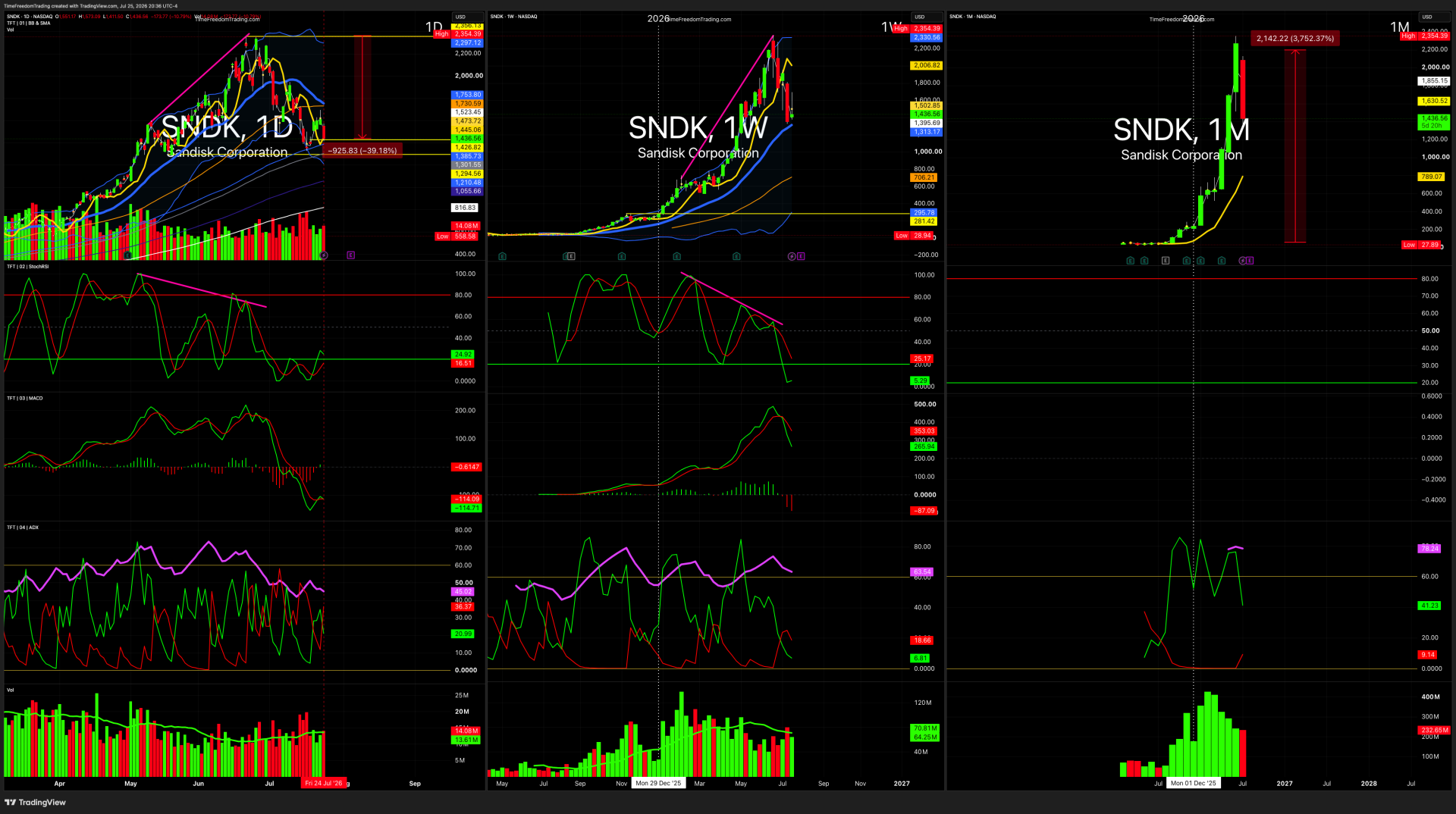
What? Sandisk dropped 10.7% Friday as memory names suffered broad distribution.
Chart setup: Crowded momentum leader breaking support with sector confirmation.
Entry trigger: Failed bounce beneath VWAP while MU, WDC and STX remained weak.
Risk: Reclaim of VWAP or sector reversal.
TFT lesson: Correlated sector weakness increases conviction. One falling stock is a problem; four falling together is information.
| Metric | Value |
|---|---|
| Direction | 🔴 Bearish |
| Friday Close | $1,436.56 |
| Friday Move | -10.7% |
| Primary Catalyst | Sector-wide Memory Stock Distribution |
| Sector | Semiconductors – Memory |
| Trade Setup | Momentum Breakdown Below Support |
| Chart Pattern | Failed Bounce → VWAP Rejection → Trend Continuation |
| Entry Trigger | Failed bounce beneath VWAP while MU, WDC and STX remained weak |
| Confirmation | Multiple memory stocks broke support simultaneously |
| Ideal Strategy | Put Debit Spread or Defined-Risk Long Puts |
| Risk / Invalidation | Reclaim of VWAP or broad memory-sector reversal |
| Relative Volume (RVOL) | High (Institutional Selling) |
| Institutional Read | Distribution Across Entire Memory Group |
| Market Theme | AI Infrastructure Rotation / Profit Taking |
| Trade Grade | ⭐⭐⭐⭐⭐ (A+) |
| 1K WAY™ Setup | Sector Confirmation Breakdown |
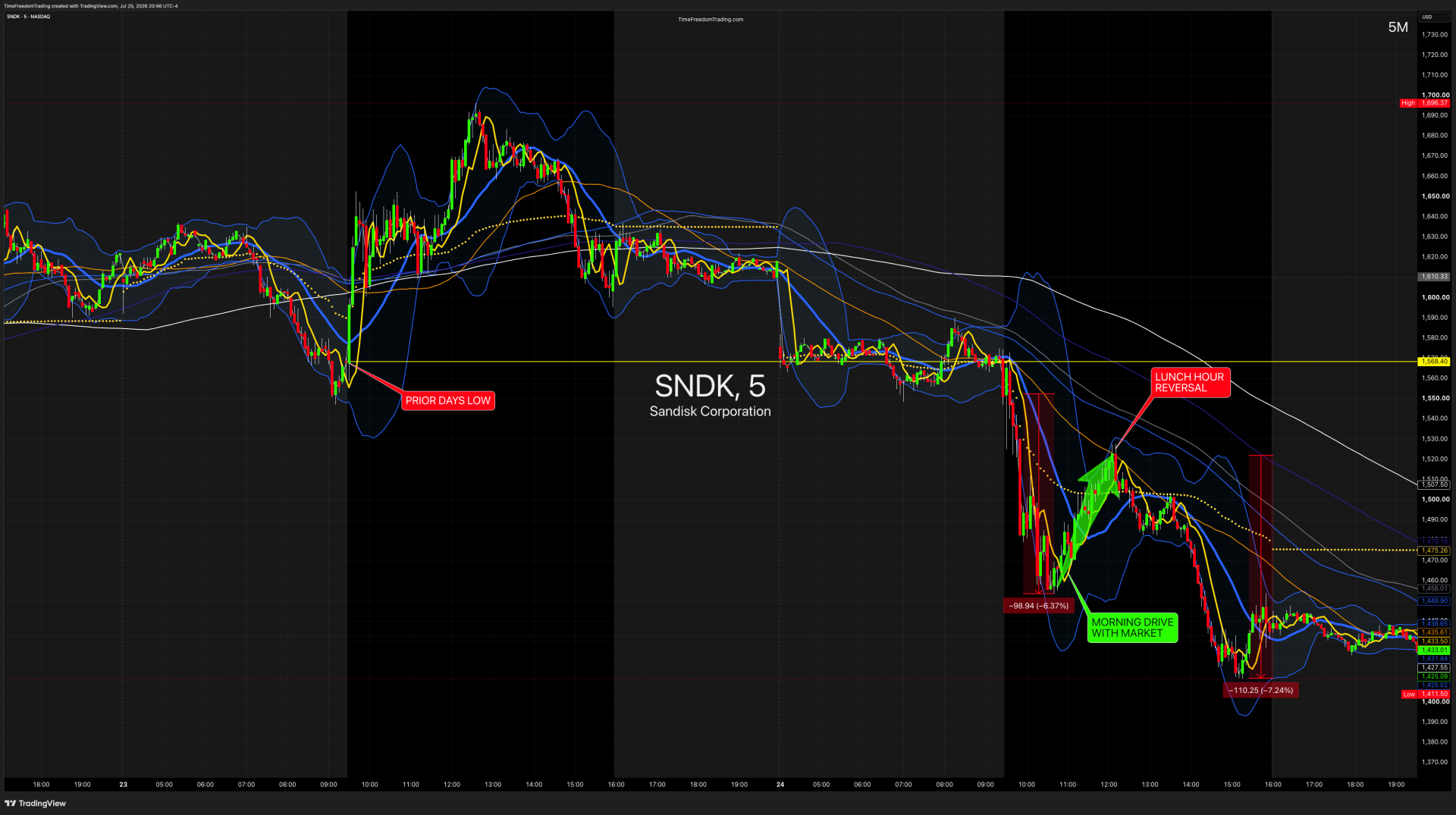
What Happened?
Sandisk experienced one of the largest declines in the semiconductor sector after falling 10.7% on Friday as investors aggressively sold memory-related AI infrastructure stocks.
Unlike an isolated earnings miss, this decline occurred alongside widespread weakness throughout the memory supply chain.
Micron, Western Digital and Seagate all traded sharply lower as institutions locked in profits across one of the market's strongest-performing groups.
The move was not company-specific.
It was sector-wide distribution.
Catalyst
This wasn't simply a Sandisk selloff.
It was a repricing of the entire memory ecosystem.
Following months of explosive gains driven by AI enthusiasm, investors began questioning whether memory manufacturers had moved too far, too fast.
Concerns centered around:
- Slowing pricing momentum
- Rising competitive pressure
- Chinese memory expansion
- Hyperscaler spending efficiency
- Rich valuations following massive AI-driven rallies
Institutions used the weakness as an opportunity to reduce exposure across the entire group.
When several industry leaders begin falling together, it usually signals sector rotation—not stock-specific news.
Chart Pattern / Setup
Momentum Breakdown with Sector Confirmation
Sandisk produced a textbook momentum breakdown.
The stock attempted an early bounce after the initial selling wave but failed beneath VWAP, confirming sellers remained in control.
Price then rolled through prior support as heavy selling expanded throughout the trading session.
Unlike many earnings trades, confirmation came not only from Sandisk's chart but from simultaneous weakness in Micron (MU), Western Digital (WDC) and Seagate (STX).
The sector confirmed the trade.
Art of the Chart
One stock breaking support can be noise.
Four leading companies breaking support together becomes institutional information.
The simultaneous breakdown across the memory sector showed that large funds were reducing exposure to the entire AI storage trade rather than reacting to one company's news.
Professional traders look beyond individual charts.
They study sector confirmation.
That confirmation significantly increases conviction.
TFT Read
Sandisk wasn't punished because AI demand disappeared.
It was repriced because institutions rotated capital out of one of the market's most crowded winners.
The memory trade had become one of Wall Street's favorite AI themes.
When positioning becomes crowded, institutions often take profits simultaneously.
This is one of the most important concepts in sector trading:
Money rarely leaves one company.
Money usually leaves an entire theme.
TFT Lesson
Never analyze a stock in isolation.
Always ask:
What is the rest of the sector doing?
Instead, wait for confirmation through:
- Weak relative strength across peer companies
- VWAP rejection
- Failed relief rallies
- Heavy institutional volume
- Breakdown of multiple industry leaders simultaneously
Remember:
One falling stock is a problem.
Four falling together is information.
Sector confirmation transforms an average setup into a high-conviction trade.
Watch Next Week
Watch five key developments:
- Can Sandisk reclaim VWAP after Friday's breakdown?
- Does selling volume begin to contract?
- Can the stock stabilize above the recent low and begin forming a higher-low base?
- Do Micron, Western Digital and Seagate stop making new lows?
- Does institutional money rotate back into the semiconductor memory group following next week's major technology earnings?
If those conditions begin to develop, Sandisk could transition from an institutional momentum breakdown into a high-probability TURN™ recovery candidate.
Until then, respect the trend and avoid trying to catch a falling knife.
The Bald Bull Takeaway
The strongest trades rarely happen because of one stock.
They happen because an entire sector starts moving together.
Professional traders don't just read the chart—they read the ecosystem behind the chart.
Read the Volume.
Follow the Rotation.
Trade the Turn.
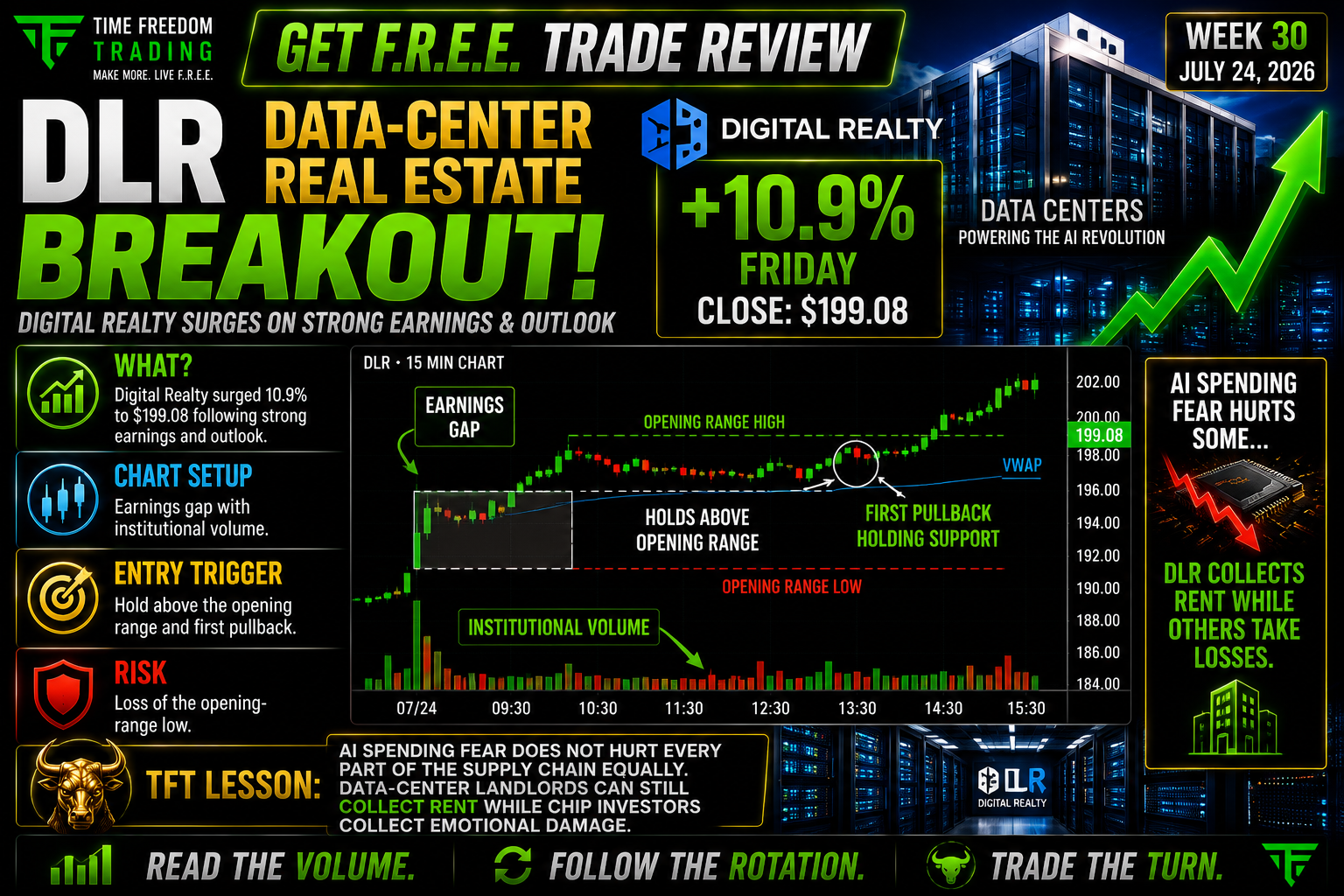
4. DLR — Data-Center Real Estate Breakout
The Trade That Proved Not Every AI Stock Was Selling Off
What? Digital Realty surged 10.9% to $199.08 following strong earnings and outlook.
Chart setup: Earnings gap with institutional volume.
Entry trigger: Hold above the opening range and first pullback.
Risk: Loss of the opening-range low.
TFT lesson: AI spending fear does not hurt every part of the supply chain equally. Data-center landlords can still collect rent while chip investors collect emotional damage.
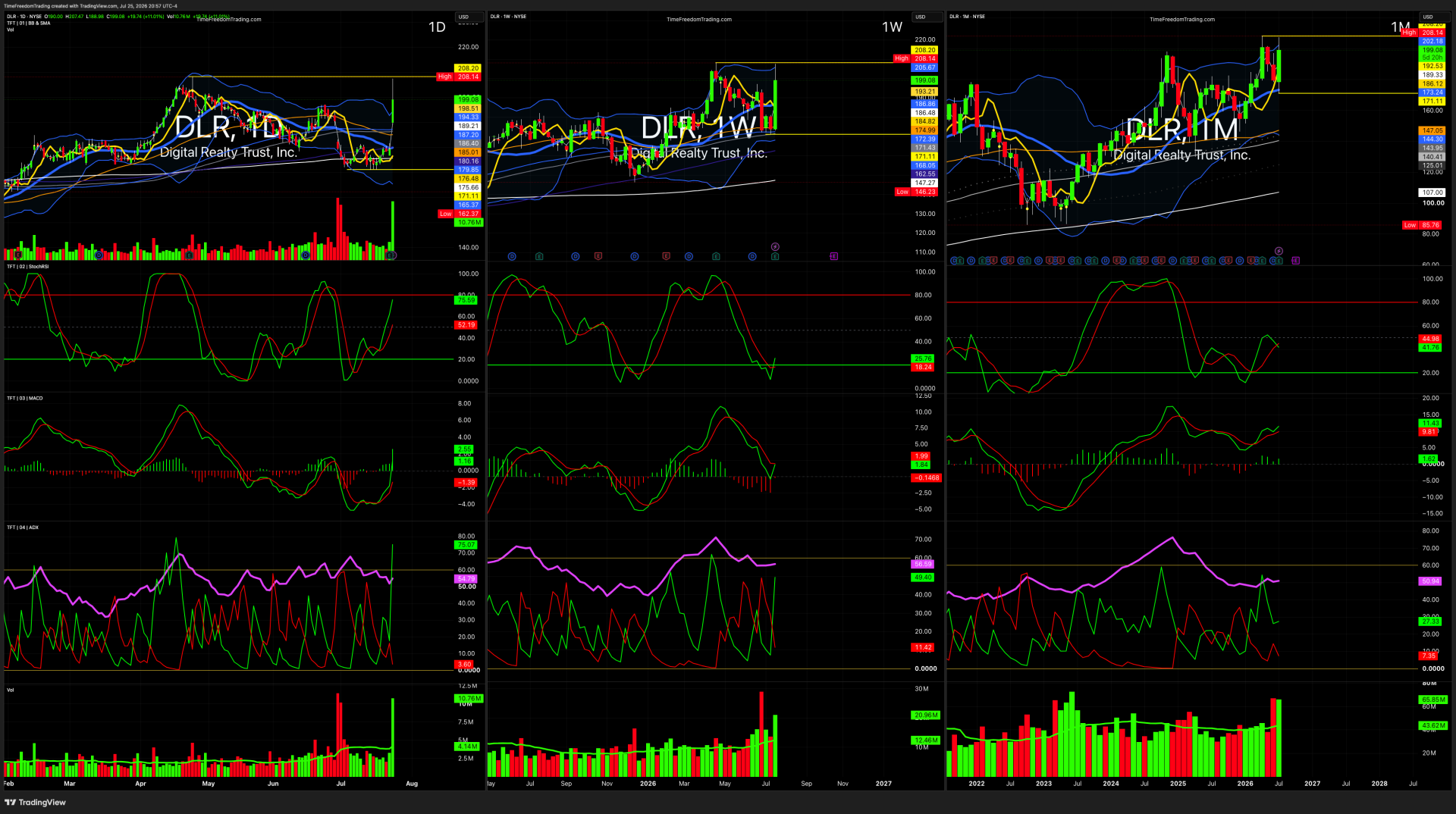
| Metric | Value |
|---|---|
| Direction | 🟢 Bullish |
| Friday Close | $199.08 |
| Friday Move | +10.9% |
| Primary Catalyst | Strong Earnings + Raised Outlook |
| Sector | Data Center REITs / Digital Infrastructure |
| Trade Setup | Earnings Gap Breakout |
| Chart Pattern | Gap-Up → Opening Range Hold → Trend Continuation |
| Entry Trigger | Hold above the Opening Range followed by the first controlled pullback |
| Confirmation | Institutional buying with elevated volume and higher highs |
| Ideal Strategy | Call Debit Spread or Defined-Risk Long Calls |
| Risk / Invalidation | Loss of the Opening-Range Low |
| Relative Volume (RVOL) | High (Institutional Accumulation) |
| Institutional Read | Accumulation |
| Market Theme | AI Infrastructure Winners |
| Trade Grade | ⭐⭐⭐⭐⭐ (A+) |
| 1K WAY™ Setup | Earnings Gap & Go |
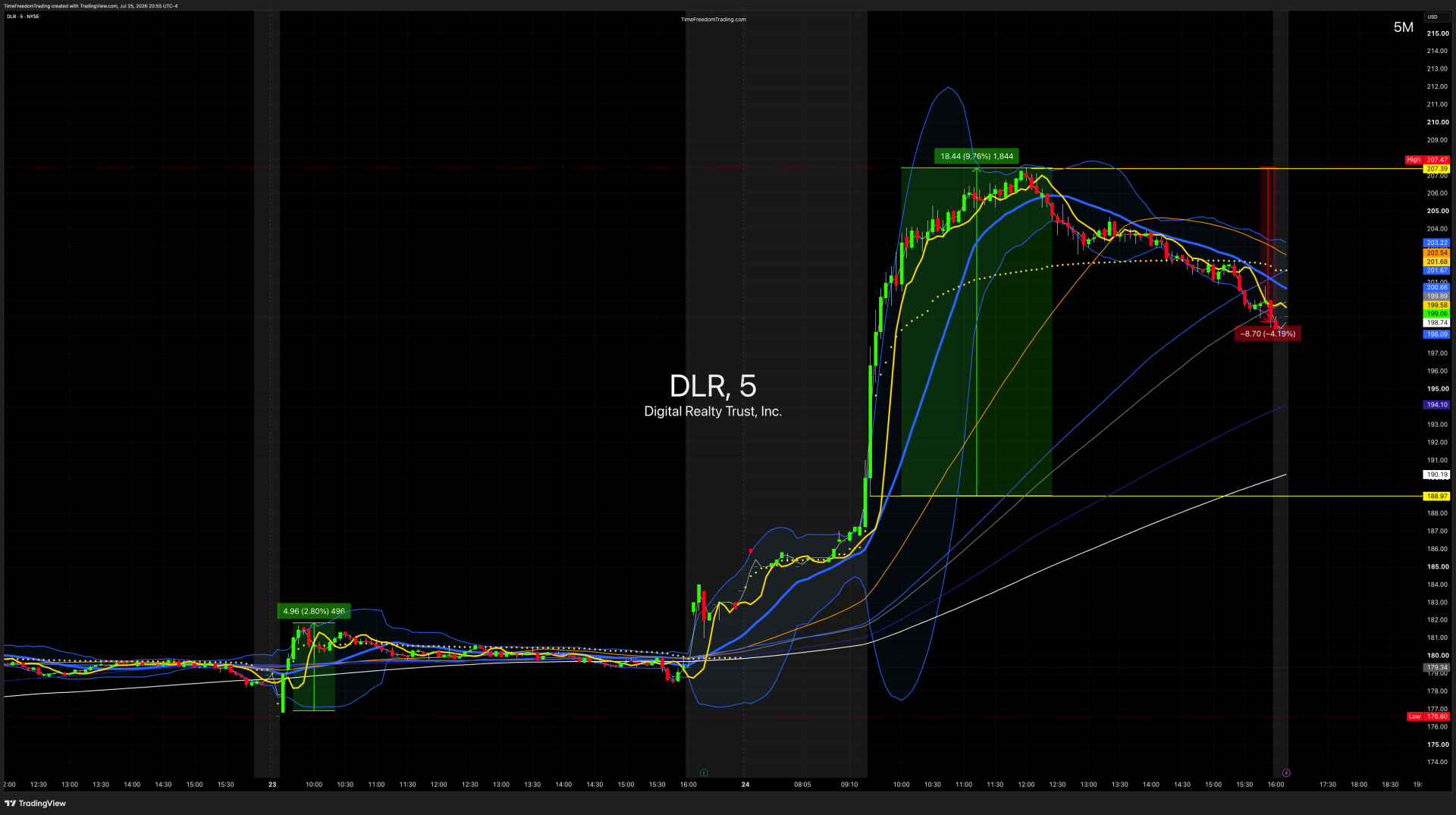
What Happened?
Digital Realty became one of the week's strongest earnings winners after reporting better-than-expected results and issuing a positive outlook driven by accelerating demand for AI infrastructure.
While semiconductor stocks were falling on concerns over rising AI capital expenditures, Digital Realty rallied because it owns one of the most valuable assets in the AI ecosystem:
The buildings where AI lives.
The stock surged 10.9% on Friday, closing at $199.08 as institutions aggressively accumulated shares following the earnings release.
Catalyst
This wasn't simply a strong earnings report.
It was confirmation that AI infrastructure demand continues to expand beyond semiconductor manufacturers.
Every AI server...
Every GPU cluster...
Every hyperscale cloud deployment...
Needs secure, power-dense data-center capacity.
Digital Realty collects rent regardless of which AI chip eventually wins.
That recurring revenue model became increasingly attractive as investors rotated away from companies spending billions on AI and toward businesses monetizing the infrastructure required to support it.
The market rewarded dependable cash flow instead of uncertain capital spending.
Chart Pattern / Setup
Earnings Gap Breakout
Digital Realty produced a textbook institutional earnings continuation pattern.
The stock opened sharply higher following earnings, creating a clean earnings gap above prior resistance.
Unlike many earnings gaps that immediately reverse, DLR held firmly above the Opening Range, absorbed early profit-taking, and formed a controlled first pullback above VWAP.
That successful retest confirmed institutional buyers remained active.
Once the opening range held, the stock continued trending higher throughout the session, completing one of the cleanest "Gap & Go" setups of earnings season.
Art of the Chart
Not every AI-related stock traded lower this week.
The chart illustrated a critical distinction between AI builders and AI landlords.
While many semiconductor names failed after earnings, Digital Realty demonstrated persistent institutional accumulation.
The combination of:
- A strong earnings gap
- Elevated volume
- Holding above the opening range
- Higher highs throughout the day
Created one of the highest-quality continuation setups of the week.
Professionals recognize that the strongest earnings gaps rarely revisit their opening lows.
DLR never gave sellers that opportunity.
TFT Read
Digital Realty wasn't rising despite AI spending concerns.
It was rising because of them.
As hyperscalers continue investing billions into AI infrastructure, demand for high-density data-center capacity increases regardless of which semiconductor company ultimately dominates the market.
This trade reinforced one of the biggest lessons of Week 30:
Capital doesn't abandon an investment theme.
It rotates within it.
Money moved away from companies funding AI and toward companies earning income from AI infrastructure.
That distinction matters.
TFT Lesson
AI spending fear does not hurt every part of the supply chain equally.
Instead, ask:
Who gets paid regardless of who wins?
The strongest earnings breakouts typically show:
- High Relative Volume (RVOL)
- Clean earnings gaps
- Opening-range support
- Controlled pullbacks
- Immediate continuation with higher highs
Remember:
Data-center landlords can still collect rent while chip investors collect emotional damage.
Sometimes the best AI trade isn't the company designing the chips.
It's the company leasing the real estate that houses them.
Watch Next Week
Watch five key developments:
- Can Digital Realty continue holding above the earnings gap?
- Does price remain above VWAP during intraday pullbacks?
- Can institutional buying volume remain elevated?
- Do other data-center infrastructure names begin outperforming?
- Does continued hyperscaler AI spending reinforce demand for digital infrastructure REITs?
If those conditions continue, Digital Realty could transition from an earnings breakout into a sustained institutional leadership trend.
The Bald Bull Takeaway
Markets don't just reward innovation—they reward monetization.
During Week 30, Digital Realty reminded traders that owning the infrastructure supporting AI can sometimes be a better business than funding the race itself.
Read the Volume.
Follow the Rotation.
Trade the Turn.
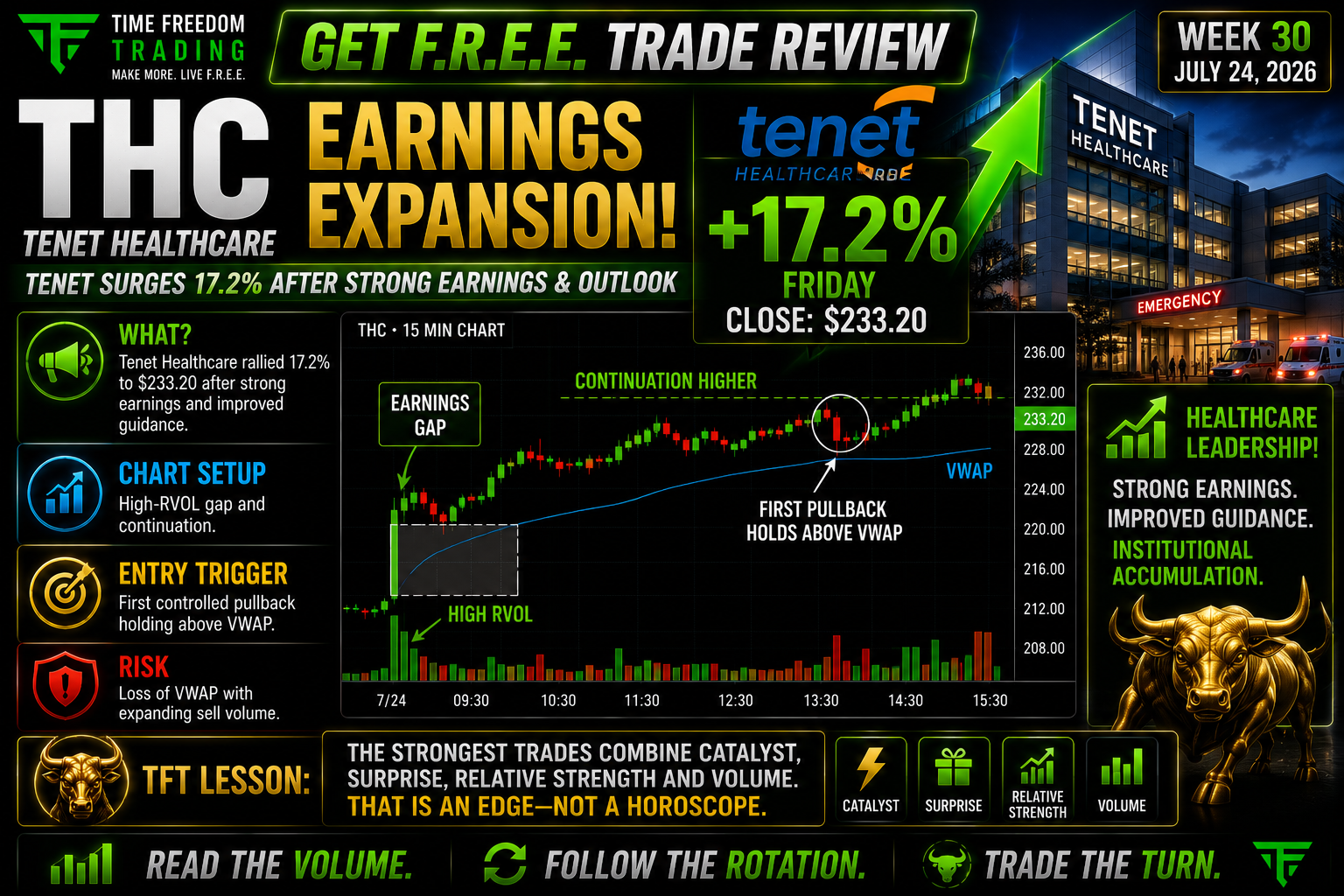
5. THC — Earnings Expansion
The Trade That Reminded Traders There Is Always Leadership Somewhere
What? Tenet Healthcare rallied 17.2% to $233.20 after strong earnings and improved guidance.
Chart setup: High-RVOL gap and continuation.
Entry trigger: First controlled pullback holding above VWAP.
Risk: Loss of VWAP with expanding sell volume.
TFT lesson: The strongest trades combine catalyst, surprise, relative strength and volume. That is an edge—not a horoscope.
| Metric | Value |
|---|---|
| Direction | 🟢 Bullish |
| Friday Close | $233.20 |
| Friday Move | +17.2% |
| Primary Catalyst | Strong Earnings + Raised Full-Year Guidance |
| Sector | Healthcare / Hospitals |
| Trade Setup | High-RVOL Earnings Gap & Continuation |
| Chart Pattern | Earnings Gap → First Pullback → Continuation Higher |
| Entry Trigger | First controlled pullback holding above VWAP |
| Confirmation | High Relative Volume (RVOL) with higher highs and strong relative strength |
| Ideal Strategy | Defined-Risk Long Calls/ Sell High of day for retracement. |
| Risk / Invalidation | Loss of VWAP with expanding sell volume |
| Relative Volume (RVOL) | Exceptionally High (Institutional Accumulation) |
| Institutional Read | Aggressive Buying / Accumulation |
| Market Theme | Defensive Growth Leadership |
| Trade Grade | ⭐⭐⭐⭐⭐ (A+) |
| 1K WAY™ Setup | Earnings Gap & Go |
What Happened?
Tenet Healthcare became one of the week's strongest earnings winners after reporting results that exceeded Wall Street expectations and raising forward guidance.
While much of the market wrestled with AI capital-spending concerns and technology-sector volatility, institutions rotated aggressively into healthcare names producing strong earnings, improving margins, and predictable cash flow.
The stock surged 17.2% on Friday, closing at $233.20, making it one of the highest relative-strength names of the week.
This wasn't simply an earnings rally.
It was institutional accumulation.
Catalyst
This wasn't about artificial intelligence.
It was about execution.
Tenet delivered exactly what Wall Street rewards:
- Strong earnings
- Improved guidance
- Margin expansion
- Positive outlook
- Healthy cash-flow expectations
At a time when investors questioned whether AI spending would eventually become profitable, Tenet showed profits that already existed.
Capital naturally rotated toward certainty.
The market rewarded results—not promises.
Chart Pattern / Setup
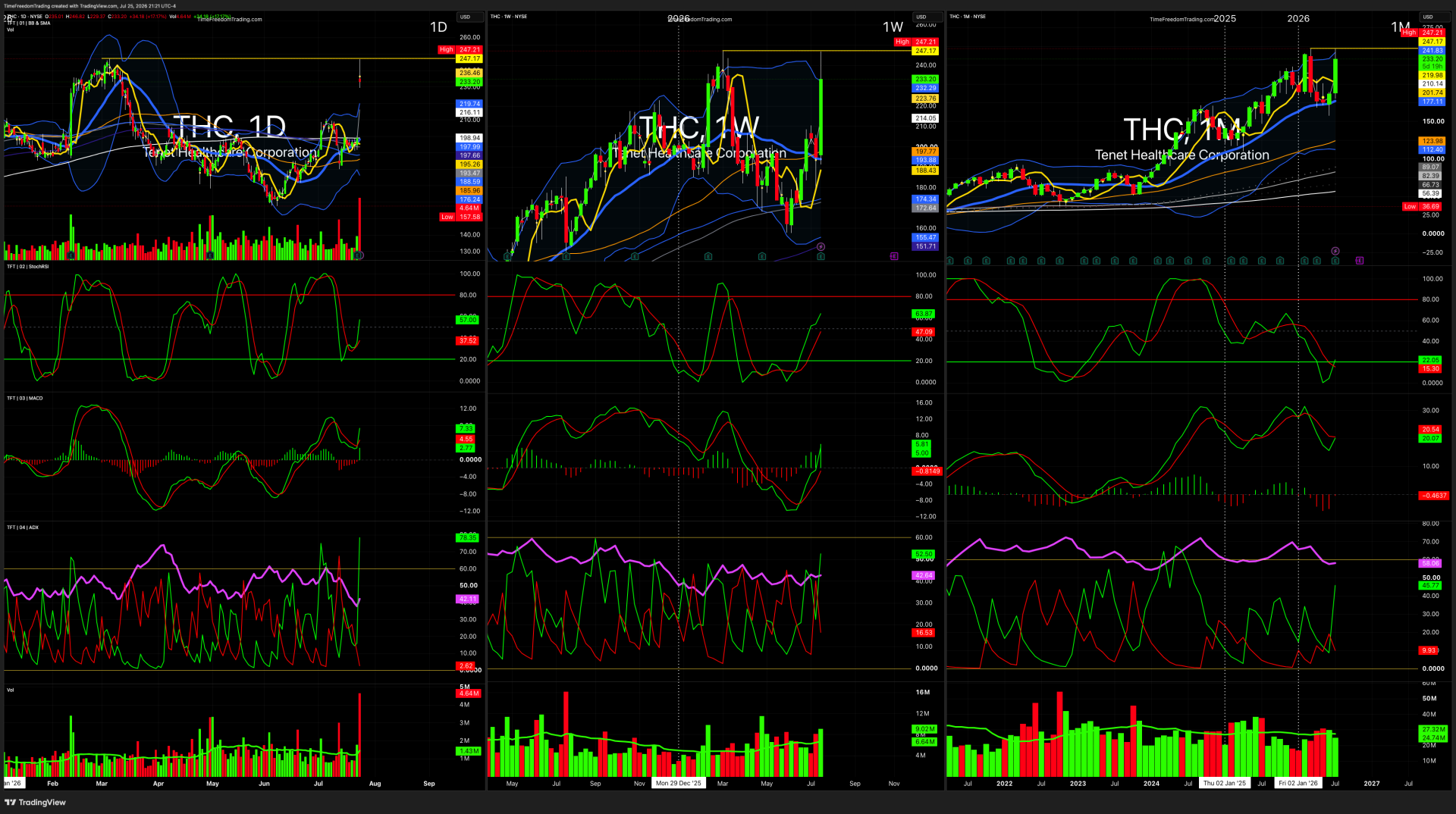
High-RVOL Gap & Continuation
Tenet produced one of the cleanest institutional earnings breakouts of the week.
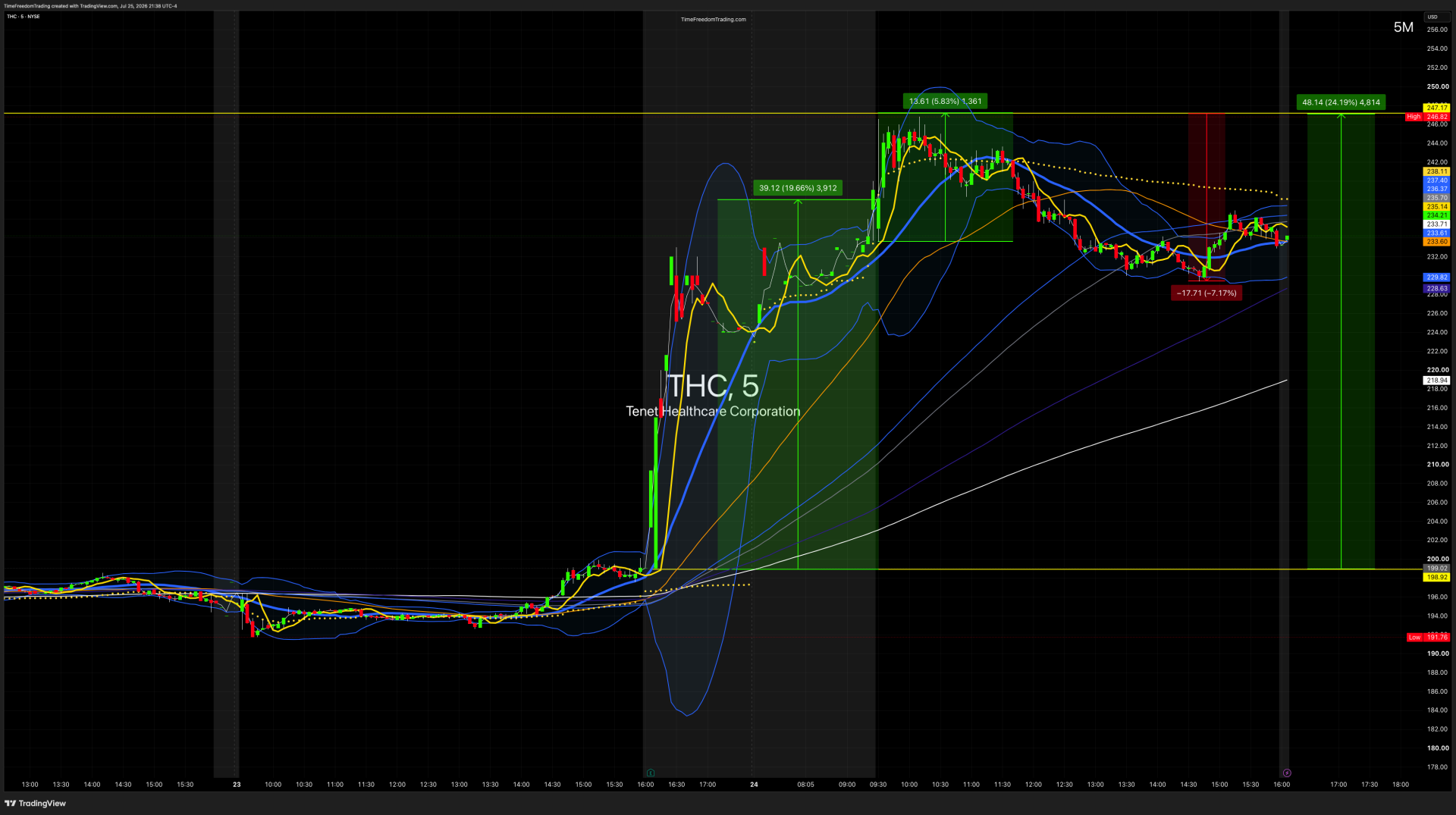
The stock gapped sharply higher following earnings on exceptionally high relative volume (RVOL), signaling immediate institutional participation.
Rather than chasing the opening surge, professional traders waited for the first controlled pullback.
Price held above VWAP, buyers stepped back in, and the stock resumed its advance into the close.
That pullback became the low-risk entry.
Art of the Chart
Strong earnings alone don't create great trades.
Strong earnings combined with exceptional volume, relative strength, and disciplined price action do.
The chart displayed every characteristic of institutional accumulation:
- High RVOL
- Clean earnings gap
- Orderly first pullback
- VWAP support
- Higher highs
- Persistent buying pressure
When institutions buy throughout the day instead of taking profits, the chart tells the story before the headlines do.
TFT Read
Tenet wasn't simply outperforming healthcare.
It was outperforming the entire market.
Week 30 reinforced one of the most important lessons in trading:
Leadership always exists.
Even during weeks when technology struggles, institutional money continues searching for companies delivering accelerating earnings and improving fundamentals.
Money didn't leave the market.
It changed sectors.
That is rotation.
TFT Lesson
The strongest trades rarely rely on one factor.
High-probability setups combine multiple institutional advantages.
Look for the convergence of:
- A meaningful catalyst
- Positive earnings surprise
- Elevated Relative Volume (RVOL)
- Relative Strength versus the market
- Clean technical structure
-
Institutional accumulation
When all six align, probabilities improve dramatically.
Remember:
The strongest trades combine catalyst, surprise, relative strength, and volume.
That is an edge—not a horoscope.
Watch Next Week
Watch five key developments:
- Can Tenet continue holding above VWAP after the earnings breakout?
- Does volume remain above average as institutions continue accumulating shares?
- Can the stock establish a new support level above $233?
- Does healthcare continue outperforming technology during earnings season?
- Will additional healthcare earnings reinforce sector leadership?
If these conditions continue, Tenet could evolve from an earnings breakout into a sustained institutional leadership trend.
The Bald Bull Takeaway
The market is always rewarding something.
Your job isn't to predict where money should go.
Your job is to identify where institutions are actually putting it.
Week 30 reminded us that while traders obsessed over AI headlines, healthcare quietly delivered one of the highest-probability earnings trades of the week.
Read the Volume.
Follow the Rotation.
Trade the Turn.
WEEK 31 : THE WEEK AHEAD
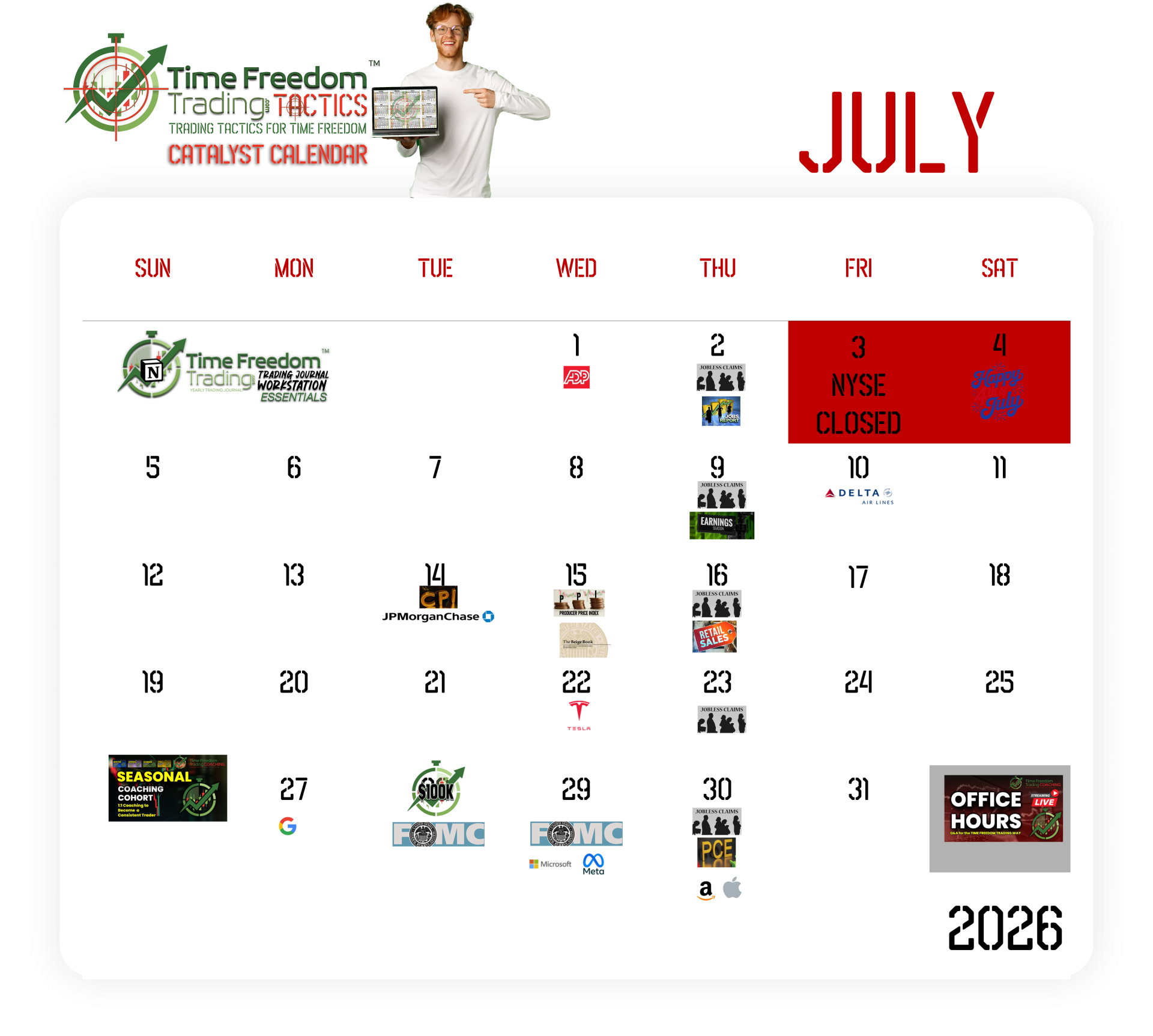
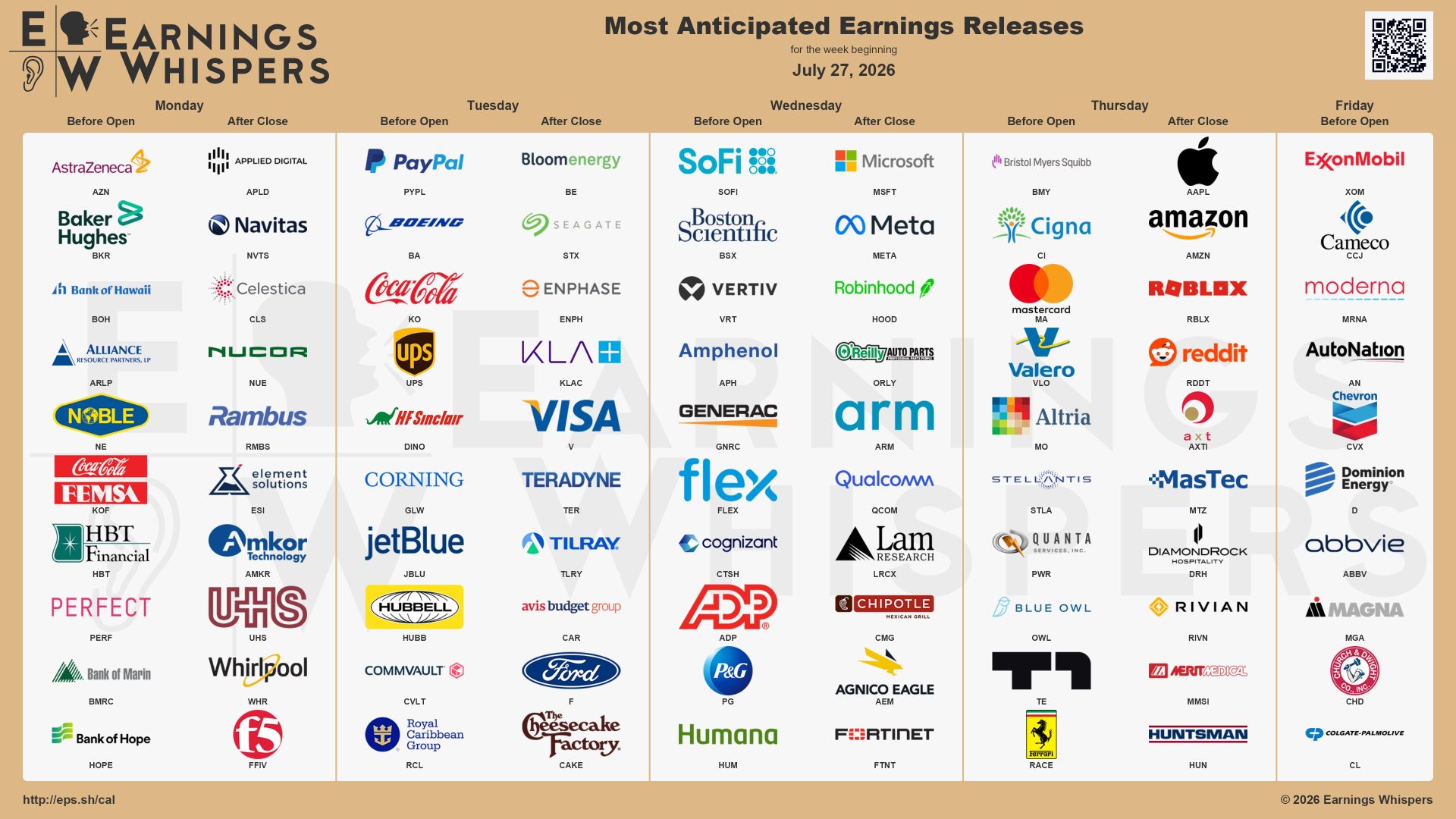
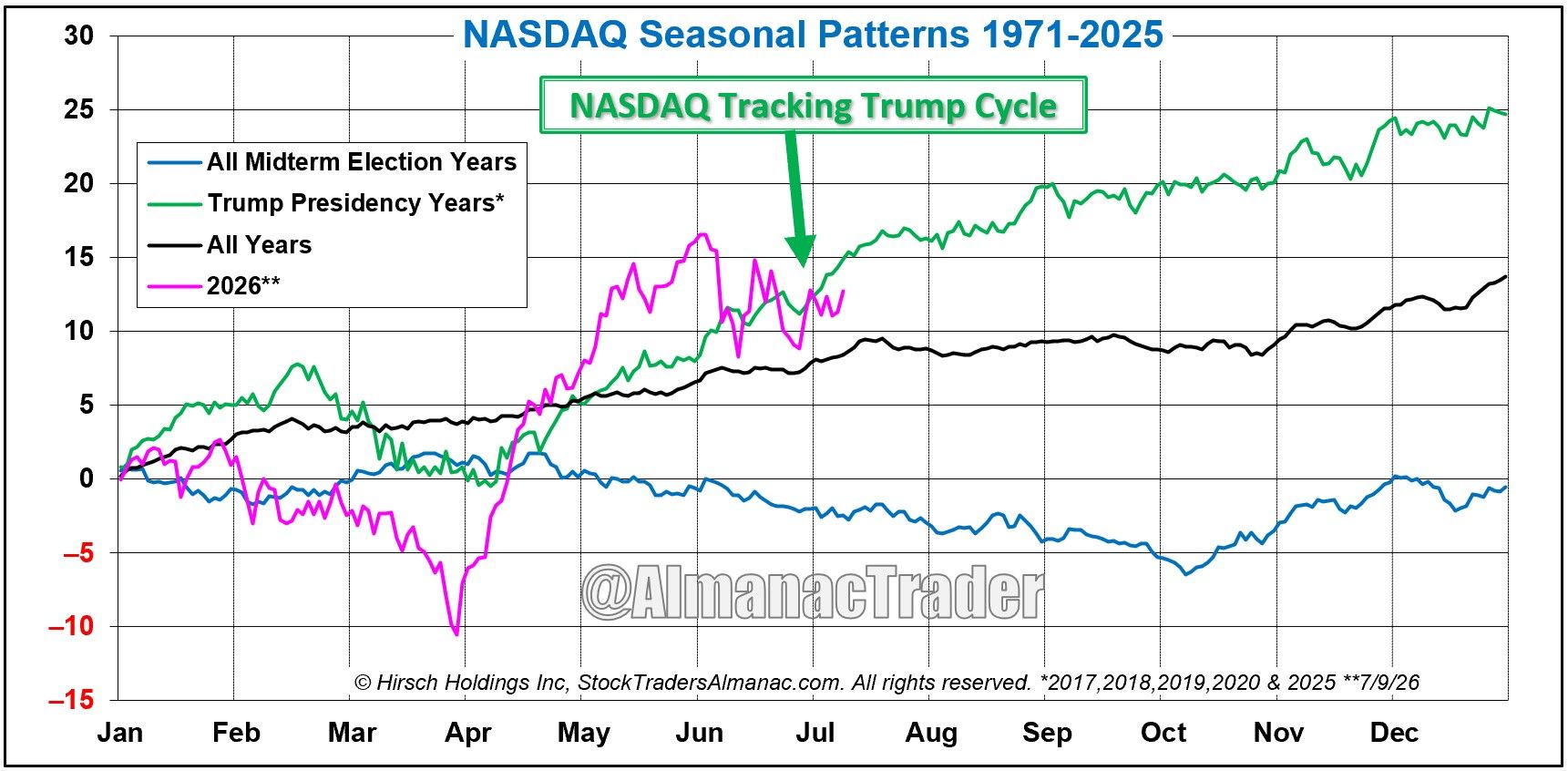
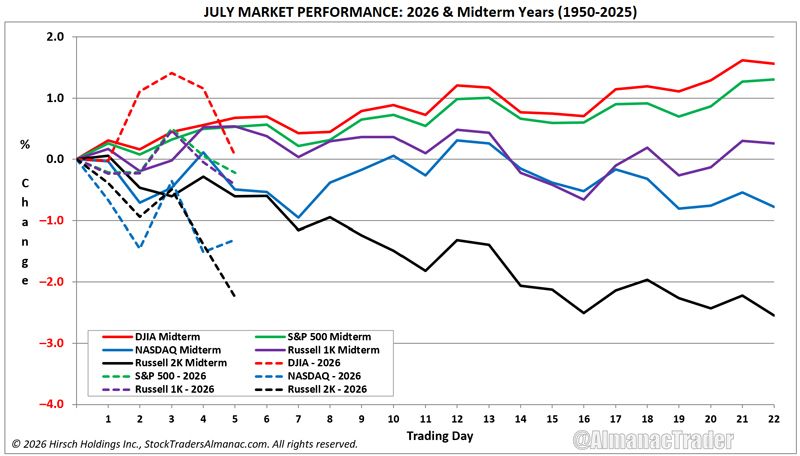

Week 31 Outlook
— July 27–31, 2026
The Battle Between AI Reality
and AI Expectation
🟢 STRENGTHS
Capital Didn't Leave the Market—It Rotated
One of the healthiest developments from Week 30 was that institutional money did not flee equities altogether. Instead, it rotated away from richly valued mega-cap technology into sectors with stronger earnings visibility and more attractive valuations. Energy, industrials, materials, healthcare, and data-center infrastructure all attracted meaningful institutional inflows while speculative AI leaders absorbed profit taking.
This distinction matters because true bear markets are characterized by broad liquidation across nearly every sector. That wasn't the case this week. Investors weren't abandoning risk assets—they were reallocating capital toward companies demonstrating current earnings power rather than distant AI promises. Digital Realty and Tenet Healthcare illustrated this perfectly: businesses with tangible cash flow and improving guidance were rewarded even as technology leaders stumbled.
Another encouraging sign was the resilience of corporate earnings outside of the AI ecosystem. Companies with strong execution, improving margins, and disciplined guidance continued to outperform, reinforcing the idea that stock selection—not simply index exposure—will likely define the next phase of this market. If leadership broadens beyond the Magnificent Seven, the bull market becomes healthier and less dependent on a handful of names.
TFT Read:
This is constructive rotation—not panic selling. Professional traders should continue following sectors attracting institutional sponsorship instead of assuming every AI-related pullback signals the end of the bull market.
🟡 WEAKNESSES
Wall Street Finally Questioned the AI Spending Arms Race
The biggest weakness emerging from Week 30 was the market's changing attitude toward AI capital expenditures. For nearly two years, investors rewarded companies simply for announcing larger AI investments. That narrative changed dramatically this week.
Alphabet, Tesla, Intel, and several semiconductor companies reminded investors that AI infrastructure requires extraordinary capital before it generates meaningful free cash flow. Wall Street is beginning to ask a far more sophisticated question:
"When do these billions of dollars actually become profits?"
Technology valuations remain historically elevated, leaving little room for execution mistakes. When expectations are priced for perfection, even strong earnings can produce negative stock reactions if management increases spending faster than profitability. Intel became the clearest example of this phenomenon: the company beat earnings estimates yet sold off sharply because investors focused on rising capital expenditures rather than the quarterly headline.
The semiconductor memory group also highlighted another weakness—crowded positioning. Sandisk, Micron, Western Digital, and Seagate all suffered coordinated institutional selling as investors harvested gains from one of the market's strongest year-to-date themes.
TFT Read:
The AI story remains intact, but the valuation story has changed. Institutions are no longer paying premium multiples simply because a company mentions artificial intelligence.
🟢 OPPORTUNITIES
The Biggest Week of Earnings Season Could Reset Market Leadership
Week 31 may become the most important week of the entire quarter.
Microsoft, Meta, Apple, and Amazon now carry the burden of proving that enormous AI investments are beginning to translate into revenue growth, operating leverage, and expanding margins. Their earnings reports will determine whether investors regain confidence in mega-cap technology or continue rotating into value-oriented sectors.
If these companies demonstrate that AI spending is producing measurable financial returns, technology leadership could quickly reassert itself and trigger powerful recoveries in semiconductors, cloud infrastructure, and software. On the other hand, if management teams emphasize additional spending without improved profitability, the market may continue rewarding sectors with immediate cash-flow visibility.
Opportunities also extend beyond technology. Healthcare, industrial automation, energy infrastructure, utilities, and data-center REITs continue benefiting from broad institutional rotation. Traders willing to follow relative strength rather than yesterday's headlines may find abundant opportunities outside the traditional AI winners.
Volatility itself also creates opportunity. Large earnings gaps often produce some of the highest-probability intraday setups of the year, provided traders remain patient enough to wait for confirmation rather than reacting emotionally to headlines.
TFT Read:
The best opportunities next week may not come from predicting earnings—they may come from trading the institutional reaction after the announcements.
🔴 THREATS
Higher Rates, Oil Prices, and AI Disappointment Could Compound Selling Pressure
Several macro risks remain capable of extending the recent technology correction.
The first is interest rates. The 10-year Treasury yield remains elevated near 4.68%, maintaining pressure on long-duration growth stocks whose valuations depend heavily on future earnings. Any further increase in yields could compress technology multiples even if earnings remain respectable.
Energy also re-emerged as a macro threat. Brent crude briefly traded above $100 before closing lower, reminding investors that geopolitical tensions remain capable of reigniting inflation concerns. Higher oil prices function as an economic tax, reducing consumer purchasing power while limiting the Federal Reserve's flexibility to ease monetary policy.
The greatest near-term threat, however, remains earnings execution. If Microsoft, Meta, Apple, or Amazon deliver another round of accelerating AI capital expenditures without convincing evidence of improving returns, institutional investors may continue reducing exposure to crowded technology positions. Such an outcome could spread selling pressure into software, semiconductors, and broader growth sectors.
Finally, sentiment itself has shifted. Markets have transitioned from rewarding AI enthusiasm to scrutinizing AI economics. That psychological change often lasts longer than traders initially expect.
TFT Read:
The biggest risk next week isn't bad earnings. It's good earnings that fail to justify premium valuations. When expectations outrun reality, even positive news can become a catalyst for selling.
TFT Strategic Conclusion
Week 30 wasn't a story about the death of AI.
It was the beginning of AI Accountability.
Wall Street has stopped asking "Who is spending the most?" and started asking "Who is earning the most?"
That subtle shift changes everything.
For traders, the edge isn't predicting the next headline—it's recognizing where institutions are moving capital after the headline is released.
Read the Volume. Follow the Rotation. Trade the Turn.
“Everyone gets what
they want out of the market.”
— Ed Seykota
DAY-BY-DAY CATALYST CALENDAR
| Day | Key Economic Catalysts | Major Earnings | Sectors / Stocks to Watch | TFT Game Plan |
|---|---|---|---|---|
| 🟢 Mon July 27 | • Durable Goods Orders• AI Infrastructure Earnings Begin | APLD, selected infrastructure names | 🏗️ Industrials⚡ AI Infrastructure🏢 Data Center REITs | Look for institutional rotation into infrastructure plays. Watch whether capital continues flowing into industrials and data centers while technology consolidates. Stay patient ahead of the Fed meeting. |
| 🟡 Tues July 28 | Consumer Confidence• Case-Shiller Home Price Index• FOMC Meeting Begins | Visa (V) Coca-Cola (KO) PayPal (PYPL) Boeing (BA) Seagate (STX) KLA (KLAC) | 💳 Payments🥤 Consumer Staples✈️ Aerospace💾 Memory🖥️ Semiconductors | Focus on memory stocks after last week's selloff. Strong reactions from STX or KLAC could signal institutional buying returning to semis before mega-cap earnings. |
| 🔥 Wed July 29 | FOMC Interest Rate Decision (2:00 PM ET) Fed Press Conference (2:30 PM ET) | Microsoft (MSFT) Meta (META) ARM Qualcomm (QCOM) Robinhood (HOOD) SoFi(SOFI)Vertiv(VRT) | ☁️ Cloud Computing🤖 AI Infrastructure🖥️ Software📱 Semiconductors | Highest-volatility day of the week. Let the first move happen. Wait for Opening Range and VWAP before entering trades. Institutions—not headlines—will determine direction. |
| 🍎 Thurs July 30 | Advance Q2 GDP Weekly Jobless Claims | Apple (AAPL) Amazon (AMZN) Mastercard(MA) Cigna (CI) Bristol Myers (BMY) | 🍎 Consumer Tech📦 E-Commerce☁️ Cloud💳 Payments🏥 Healthcare | Apple and Amazon must prove AI spending is becoming profitable. Trade the post-earnings reaction—not the earnings announcement. Look for institutional follow-through or failed gaps. |
| 🔴 Fri July 31 | PCE Inflation Index (Fed's Preferred Inflation Measure)• Employment Cost Index | ExxonMobil (XOM) Chevron (CVX) AbbVie (ABBV) Moderna (MRNA) | ⛽ Energy🛢️ Oil💊 Healthcare🧬 Biotech | Finish the week by identifying the sectors institutions accumulated all week. PCE could influence interest-rate expectations and determine whether growth or value leads into August. |
NEXT WEEK Game Plan
What Bulls Need Next Week
The bulls need confirmation that last week’s technology weakness was rotation—not liquidation.The first requirement is stabilization in mega-cap technology. Microsoft, Meta, Apple, and Amazon do not need perfect earnings, but they do need to show that AI spending is producing measurable revenue growth, margin expansion, or stronger forward demand. The market has stopped rewarding capex announcements by themselves. Bulls now need proof that the spending is building profits rather than just building server rooms expensive enough to have their own zip codes.
The bulls also need the major indexes to defend last week’s lows. A successful retest followed by improving breadth would indicate that institutions are buying weakness rather than abandoning exposure. Watch for more stocks participating above VWAP, stronger advance-decline readings, and leadership expanding beyond a handful of defensive names.
Rates matter too. The 10-year Treasury yield needs to remain contained. A stable or lower yield would relieve pressure on long-duration growth stocks and help technology regain leadership. Bulls do not necessarily need a dovish Federal Reserve. They need a Fed that avoids introducing a fresh tightening surprise.
Finally, the bulls need continued sector participation. Energy, healthcare, industrials, materials, and data-center infrastructure helped keep the market from becoming a full-blown crime scene last week. If technology stabilizes while those groups remain firm, the market can transition into a broader and healthier advance.
| Bull Requirement | What Confirms It |
|---|---|
| Mega-cap earnings hold | MSFT, META, AAPL, and AMZN defend their earnings gaps |
| AI economics improve | Revenue, margins, and guidance justify higher capex |
| Indexes defend support | S&P 500 and Nasdaq hold last week’s lows |
| Breadth expands | More sectors and stocks participate in the advance |
| Rates stay contained | 10-year yield stabilizes or moves lower |
| VWAP holds | Earnings winners maintain intraday institutional support |
| Rotation remains constructive | Money moves between sectors instead of leaving equities |
Bull Victory Scenario
The strongest bullish outcome would be:
- The Fed avoids a hawkish surprise
- Mega-cap earnings produce defended gaps
- Semiconductors stabilize
- Treasury yields ease
- Market breadth improves
-
Defensive and cyclical leaders remain firm
That combination could turn last week’s correction into a reset and launch a broader August rally.
What Bears Need Next Week
The bears need earnings disappointment to spread beyond isolated names and become a market-wide repricing event.
Their strongest weapon is another round of good earnings followed by bad stock reactions. If Microsoft, Meta, Apple, or Amazon beat expectations but still sell off because guidance, margins, or AI returns fail to justify current valuations, the market will receive confirmation that expectations remain too high.
The bears also need Treasury yields to rise. Higher yields would pressure growth multiples, strengthen the valuation-reset narrative, and make profitable defensive sectors more attractive relative to expensive technology. A hawkish Fed message or stubborn inflation data could provide that catalyst.
Technically, bears need last week’s lows to fail. A decisive break below support with expanding volume would transform a controlled pullback into institutional distribution. That would be especially important if failed earnings gaps begin appearing across multiple sectors rather than only in technology.
The bears also need rotation to deteriorate. Last week, money moved into energy, healthcare, industrials, materials, and real estate. That kept the broader market functioning. For the bearish case to strengthen materially, those sectors must stop absorbing capital. Once both growth and defensive groups sell together, the market stops rotating and starts liquidating.
Oil and inflation could become additional pressure points. If crude pushes higher while PCE inflation remains elevated, the market may begin pricing in slower growth, tighter financial conditions, and less Federal Reserve flexibility. That is the kind of combination that can turn a valuation correction into something uglier.
| Bear Requirement | What Confirms It |
|---|---|
| Mega-cap earnings fail | Good reports produce sustained selling |
| AI capex concerns spread | Investors punish spending without clear returns |
| Support breaks | Nasdaq and S&P 500 lose last week’s lows |
| Selling volume expands | Down moves occur on high RVOL |
| Treasury yields rise | Higher rates compress growth valuations |
| Rotation breaks down | Energy, healthcare, and industrials weaken with tech |
| Inflation risk returns | Oil and PCE move higher together |
| Failed VWAP recoveries | Stocks repeatedly reject VWAP after earnings gaps |
Bear Victory Scenario
The strongest bearish outcome would be:
- The Fed sounds more restrictive
- Treasury yields rise
- Mega-cap earnings gaps fail
- AI capex concerns deepen
- Semiconductors make new lows
- Breadth weakens across sectors
- Friday inflation data remains stubborn
That would suggest the market is moving beyond simple rotation and into a broader valuation reset.
“Earnings are an opinion;
cash flow is a fact.”
| Alfred Rappaport

WELCOME TO
SUMMER TRADING!!!!
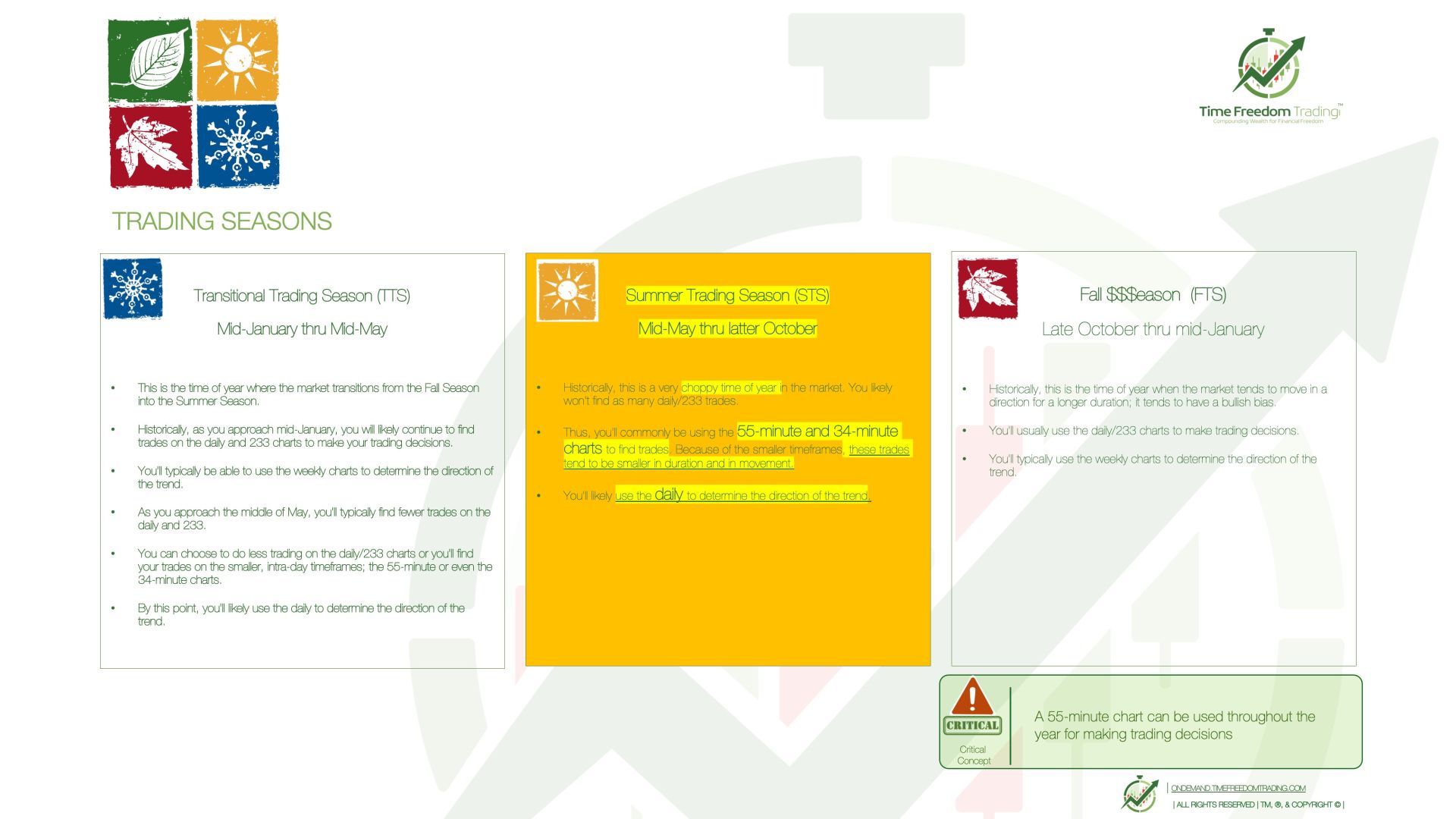
The Stock market does NOT repeat...
but it does rhyme!
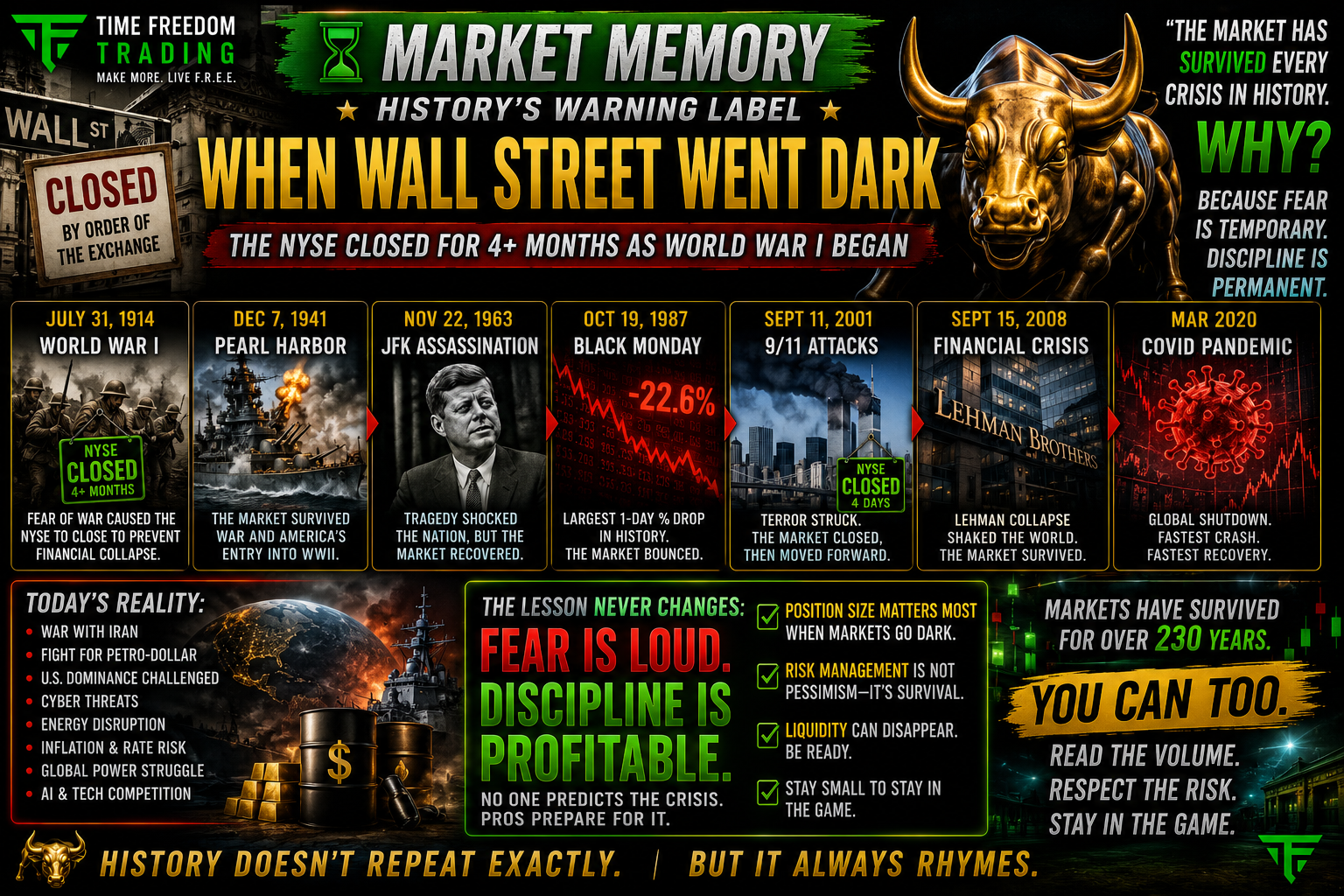
History Doesn't Repeat... It Rhymes
Market Memory
July 31, 1914 — When Wall Street Went Dark
WHAT HAPPENED?
On July 31, 1914, as Europe descended into World War I, the New York Stock Exchange made an unprecedented decision to suspend trading.
The exchange remained closed for more than four months, the longest continuous shutdown in its history.
The concern wasn't simply falling stock prices.
European governments, banks, and investors urgently needed cash to finance the war. Officials feared foreign investors would dump massive amounts of American securities, creating a financial panic, draining U.S. gold reserves, and collapsing confidence in the banking system.
Rather than allow uncontrolled liquidation, Wall Street simply stopped trading until stability returned.
Ironically, the United States emerged from World War I as the world's dominant financial power, replacing London as the center of global finance.
Sometimes history's greatest crisis creates tomorrow's greatest opportunity.
WHY DID IT MATTER?
This event permanently changed how governments, central banks, and financial markets prepare for systemic risk.
It demonstrated that liquidity is not guaranteed.
Most investors assume markets will always be open, buyers will always exist, and capital can always be accessed.
History proves otherwise.
When geopolitical events become severe enough, protecting the financial system sometimes becomes more important than allowing uninterrupted trading.
World War I became the first modern example that markets are connected to politics, banking, military conflict, and global confidence—not just corporate earnings.
It also established America as the world's emerging financial superpower.
THE CONNECTION TO TODAY
Today's headlines look different, but the underlying forces are remarkably familiar.
Instead of European empires competing for global dominance, investors are watching:
- Military conflict involving Iran and the broader Middle East
- Energy security and oil supply disruptions
- Competition over global reserve currencies and the future of the petrodollar
- U.S.–China strategic rivalry
- Cyber warfare and attacks on financial infrastructure
- Artificial intelligence becoming the next geopolitical arms race
- Rising government debt and fiscal deficits
- Inflation, interest rates, and central-bank credibility
Every generation believes its crisis is unprecedented.
History suggests otherwise.
Whether it was World War I...
Pearl Harbor...
The Cuban Missile Crisis...
President Kennedy's assassination...
Black Monday...
September 11th...
The Global Financial Crisis...
COVID...
Or today's geopolitical uncertainty...
The market has always faced events that appeared capable of changing the world forever.
Some did.
Yet markets adapted.
Capital evolved.
Innovation continued.
New leaders emerged.
THE TFT LESSON
Professional traders don't survive because they predict the next crisis.
They survive because they prepare for uncertainty before it arrives.
Nobody predicted:
- World War I
- Pearl Harbor
- President Kennedy's assassination
- Black Monday
- September 11th
- Lehman Brothers
- COVID-19
Likewise, nobody knows tomorrow's headline.
That uncertainty is precisely why risk management exists.
Professional traders focus on what they can control:
✔ Position sizing
✔ Defined risk
✔ Cash management
✔ Portfolio diversification
✔ Trading with probabilities instead of predictions
When everyone else is reacting emotionally...
Professionals are executing their plan.
THE BALD BULL TAKEAWAY
History rewards the prepared.
Every crisis eventually becomes another chapter in a history book.
The investors who survive aren't the ones who predict every disaster.
They're the ones who are still standing when the next bull market begins.
Remember...
Liquidity can disappear.
Volatility can explode.
Fear can become contagious.
But discipline compounds.
Because...
History doesn't repeat exactly. It always rhymes.
Read the Volume.
Respect the Risk.
Stay in the Game.
“The market pays you for being right… but only after it tests your patience.”
— Ed Seykota

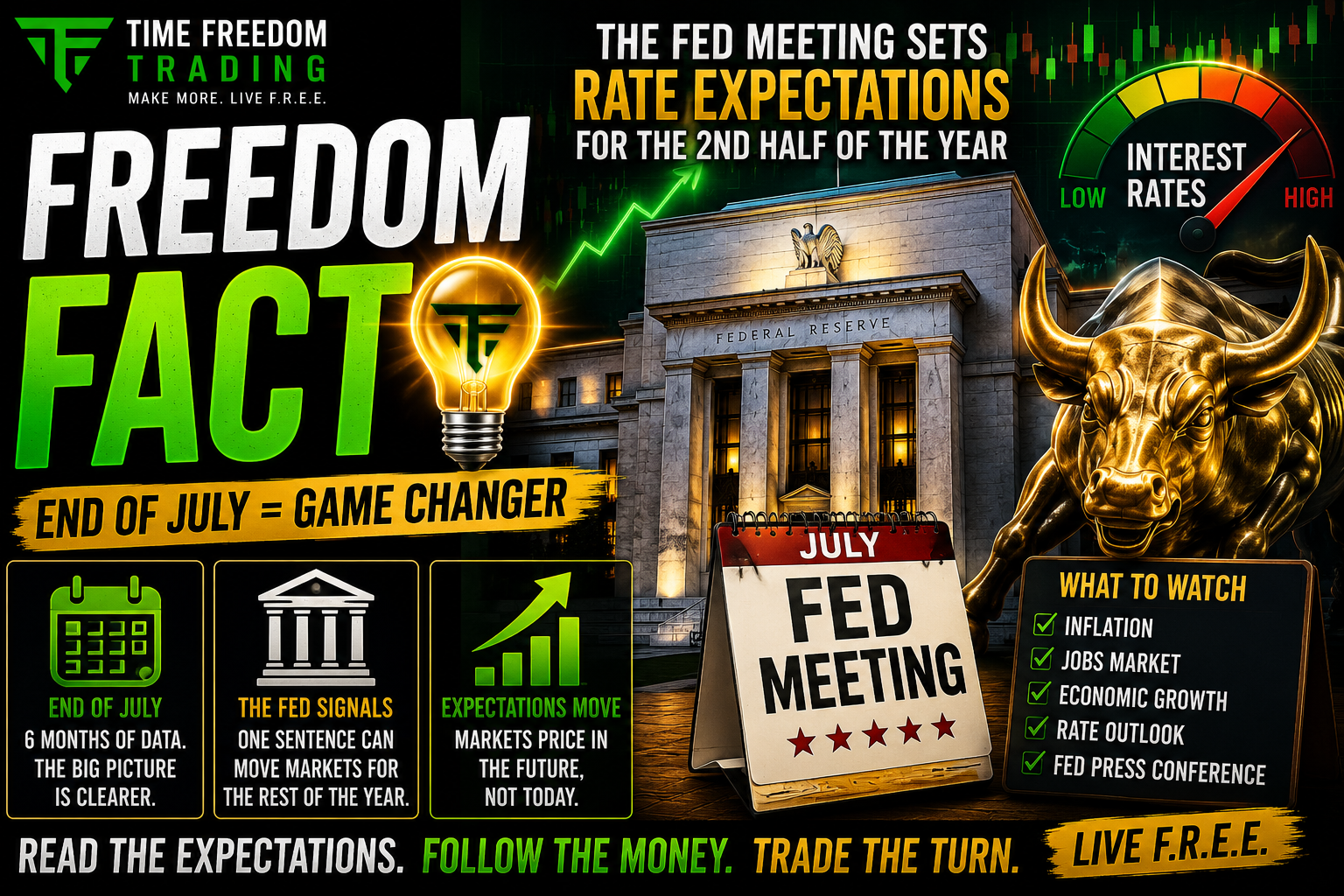
Why the End of July Often Sets the Tone for the Second Half of the Year
Every July, Wall Street reaches one of its most important decision points.
By the time the calendar turns to August, investors have received nearly six months of economic data, inflation reports, employment numbers, and corporate earnings. The Federal Reserve has enough information to evaluate whether inflation is moving toward its target, whether the economy is slowing or accelerating, and whether interest-rate policy needs to change during the remainder of the year.
That is why the late-July Federal Reserve meeting often becomes less about today's interest-rate decision and more about the roadmap for the second half of the year.
Markets don't simply react to what the Fed does.
They react to what the Fed suggests comes next.
A single sentence during the Fed Chair's press conference can move Treasury yields, the U.S. dollar, commodities, and equities because investors immediately begin repricing expectations for future interest rates.
If the Fed signals inflation is cooling and policy may become less restrictive, growth stocks, technology, and small-cap companies often respond positively.
If the Fed warns inflation remains persistent or the labor market is still too strong, expectations for higher rates tend to pressure long-duration assets while benefiting sectors such as financials and energy.
For professional traders, the July meeting marks the transition from "What has happened?" to "What is likely to happen next?"
The market spends the second half of the year pricing those expectations
TFT Freedom Lesson
Professionals don't wait for the Fed to cut rates.
They trade expectations before policy changes occur.
Markets are forward-looking machines.
By the time the Federal Reserve finally changes interest rates, institutional investors have often been repositioning portfolios for weeks—or even months.
That's why successful traders focus on expectation shifts, not headline reactions.
Remember:
The Fed moves interest rates.
The market moves expectations.
Professional traders move before both.
Read the Expectations.
Follow the Money.
Trade the Turn.
“The big money is not in
the buying or selling,
but in the waiting.”
| Jesse Livermore

"Let us not become weary in doing good, for at the proper time we will reap a harvest if we do not give up."
| Galatians 6:9
One of the greatest lies in trading is that success comes from one spectacular trade. Social media celebrates overnight millionaires, lottery-ticket options, and lucky bets, but lasting wealth has never been built that way.
The market doesn't reward excitement—it rewards consistency.
Every trading journal you complete, every stop loss you honor, every poor trade you avoid, and every dollar you choose to compound instead of consume is another seed planted in your financial future.
Most people quit because they expect a harvest after planting only a handful of seeds. Professionals understand that every disciplined decision is quietly working on their behalf, even when the results aren't immediately visible.
As we close July and enter one of the most important weeks of the quarter—with a Federal Reserve decision, mega-cap earnings, and heightened geopolitical uncertainty—remember that your objective isn't to win every trade.
Your objective is to become the kind of trader who is still executing the same disciplined process five years from now.
The market will always test your patience before it rewards your discipline.
Stay committed to your plan, trust the process, and allow compounding to do what impatience never can.
Freedom is rarely earned in one extraordinary moment. It is harvested through thousands of ordinary decisions made with extraordinary consistency.
Actionable Summary
- 🌱 Plant seeds every trading day by following your trading plan.
- 📈 Measure consistency before measuring profitability.
- 🛡️ Protect capital today so it can compound tomorrow.
- ⏳ Trust that disciplined habits produce exponential results over time.
-
🎯 Ask yourself each evening: "Did I earn the right to reap tomorrow's harvest?
The Bald Bull's Closing Charge
Every trade is a seed.
Some will fail.
Some will flourish.
But the traders who achieve financial freedom are the ones who refuse to stop planting.
Wall Street teaches people to chase quick riches.
God teaches us that every worthwhile harvest requires time, patience, and faithful work.
Don't grow weary because your account hasn't reached your destination yet.
Grow stronger because every disciplined decision is moving you one step closer to Providence.
The harvest doesn't belong to the fastest trader.
It belongs to the one who refuses to quit.
Read the Volume.
Follow the Rotation.
Trade the Turn.
THE FINAL WORD...
This week wasn't about whether artificial intelligence has a future. It was about whether investors are finally demanding that the future start paying today.
For nearly two years, Wall Street rewarded companies simply for announcing bigger AI ambitions and larger capital spending plans.
This earnings season marked a subtle—but important—shift.
Investors no longer asked, "Who is spending the most?" They asked, "Who is earning the most?"
That distinction separated the winners from the losers. Digital Realty and Tenet Healthcare were rewarded because they delivered measurable results. Several high-profile technology companies discovered that even strong earnings are no longer enough when expectations have already priced in perfection.
The market also reminded us that capital rarely disappears—it rotates. While headlines focused on weakness in mega-cap technology, institutional money quietly flowed into healthcare, energy, industrials, materials, and digital infrastructure. That's why professional traders don't marry sectors or narratives. They follow the money. Every week, institutions leave footprints through volume, relative strength, and sector rotation. Your job isn't to argue with those footprints. Your job is to recognize them before the crowd does.
As we enter one of the most important weeks of the quarter, remember that the Federal Reserve, inflation data, and earnings from Microsoft, Meta, Apple, and Amazon won't just influence stock prices—they'll shape expectations for the second half of the year. Volatility is coming. But volatility isn't the enemy.
Unpreparedness is.
At Time Freedom Trading, we don't chase headlines. We build a Wealth Operating System that transforms market uncertainty into opportunity through preparation, discipline, and consistent execution. Every disciplined trade strengthens your Financial Flywheel. Every lesson learned compounds into wisdom. Every dollar protected today becomes capital that can work for you tomorrow. Because in the end, wealth isn't measured by one winning trade.
It's measured by whether your money is working harder than you are.
PROJECT PROVIDENCE™
There comes a moment when every person has to answer a question that no paycheck, promotion, or retirement account can answer.
Do you deserve Providence... or have you simply become comfortable renting your life?
Too many people spend decades building someone else's dream while postponing their own. They rent their time to an employer, rent their financial future to Wall Street, and hope that one day they'll finally have enough freedom to live life on their own terms.
But hope is not a wealth strategy.
Providence isn't about luck.
Providence is about becoming the kind of person who prepares, compounds, serves, and steward's every opportunity entrusted to them.
The market will continue to offer opportunities.
The question is whether you'll be prepared to seize them—or spend another year watching someone else build the life you've imagined.
When history looks back on this season of your life, will it say this was the week you changed your future... or the week you decided to stay comfortable?
Your future is being built one disciplined decision at a time.
Project Providence begins the moment you decide your freedom is worth fighting for.
Read the Volume.
Follow the Rotation.
Trade the Turn.
Make More! Get F.R.E.E.
Want to
"SEE"
the Market
Correctly?
SEE the Market
Like a Time Freedom Trader!
Most people stare at charts the way rookies stare at MRI scans —
lots of squiggles… zero understanding… and a whole lot of “uhhh, is this bad?”
Time Freedom Traders don’t look at the market.
We see it — in 3D, in real time, with clarity sharp enough to slice through Wall Street noise.
We see:
-
Rotation before it rotates
-
Catalysts before they explode
-
Turns before they trend
-
Opportunities while everyone else is still doom scrolling
This is the difference between traders and operators.
One guesses.
One reads the market like a playbook.
And it starts with using the right tools.
If you want to see what we see, the way we see it —
you need charts that don’t lie, lag, or limit your edge.
That means TradingView.
- Clean charts.
- Real-time data.
- Precision tools.
- Time Freedom Trading Custom Indicators - to "See" the MOVES correctly!
Everything you need to trade the turn, not chase the move.
👉 Sign up for TradingView today and start seeing the market like a Time Freedom Trader.
Your clarity starts the moment your charts go HD.
Because remember —
You’re just one trade away.

LIVE LIKE
A SUPER HERO!
A SUPER HERO!
If you’re ready... it’s time to level up.
Join our Coaching Cohort, where we teach traders how to:
- Think like a Trader and Investor
- Build your own "consistency code"
- Grow into Profits with Providence.
No more hesitation. Just a proven path to financial freedom.
Click below to join the Time Freedom Trading Coaching Cohort and start trading the $1KWay today!
Join the TIME FREEDOM TRADING Coaching Cohort Today!
Discover how Time Freedom Trading can help you start building your Financial Flywheel and your trading plan to HIT SIX in 2026!
Freedom awaits—are you ready to claim it?
| Clinton - The "Bald Bull" James

P.S.S. PLEASE PAY IT FORWARD!
GIVE TIME FREEDOM - SHARE THIS LINK
Every one deserves Time Freedom!
If you know someone who would like to learn to earn time freedom, please forward this email / link and share the freedom!
Your network will appreciate it (and remember you) for sharing thoughtful content.
If you enjoyed this micro-lesson please share this link on social.


Get the "GET FREE" Bundle

10 TIME FREEDOM TRADING TACTICS YOU WILL LEARN!
- Learn your real freedom number to earn time freedom trading in the stock market. (it's smaller than you think!)
- Learn how to see market manipulation by large institutional investors and profit from their movements.
- Learn how to make money in an up, down, or sideways market. More importantly, you will learn a quantitative approach to know when NOT to trade in the stock market to protect your capital.
- Develop the proper paper trading skills and processes to prove your trading ability in the stock market before risking a single dollar!
- Learn the proper trading chart configurations to see the markets in 3D and clearly see market moves before your trade!
- Understand the difference between retail trading (prey) and professional trading (predator)strategies and how to profit from both mindsets in the stock market.
- Learn simple trading strategies that only require 5th-grade math. No complex calculations or buzzwords to confuse you.
- Create simple automated trading tactics with your
broker that allow you to place a simple trade on autopilot and minimize
your risk while maximizing your gain for a trade.
- Join a live daily trader community chat that will discuss market moves in real-time to accelerate your learning and close your experience gap faster.
- Experience the seasonality of the stock market with a veteran trader to learn how to profit in all months and seasons of the year to earn time freedom!
✓ Quantified Strategies: Learn to identify repeatable trading patterns to profit in the markets with systematic, data-driven methods.
✓ Practical Examples: Real-world cases, demonstrated strategies in action.
✓ Consistent Results: Strategies that have proven successful for decades are now accessible to you.




When your ready;
There are five (5) ways I can help.

1.0 Subscribe to
The GET F.R.E.E. Report
Join the Time Freedom Trading Community. SIGN UP for The GET F.R.E.E. REPORT newsletter and learn how to earn TIME FREEDOM from your INBOX! Get trading strategies and get elements of the Time Freedom Trading Operating System in your inbox! Time Freedom Awaits!
The GET F.R.E.E. REPPORT
2.0 Subscribe to
TIME FREEDOM TRADING TACTICS
Get an "investing lesson" on the 1st of every month in your inbox with simple tactics you can implement immediately to start earning time freedom.
TIME FREEDOM TRADING TACTICS
3.0 The Time Freedom Trading
ON DEMAND COURSES
The #1 On-demand Trading Curriculum for learning Trading MECHANICS, Trading DYNAMICS, Trading STRATEGY, and Trading MINDSET.
Join the TIME FREEDOM TRADER COMMUNITY in our flagship courses. Time Freedom Trading teaches you exactly how to lose less and make more by learning a simple system to compound profits in the stock market.
Come inside and get over 25 years of trading expertise, proven methods, and actionable strategies to help Main Street earn Wall Street profits by trading and investing in the stock market.
Ondemand.TimeFreedomTrading.com
4.0 The Time Freedom Trading COACHING COHORT
Join Time Freedom Traders learning "live and in real-time" the seasonality of the stock market. This comprehensive Trader Coaching Cohort will teach you 1:1, in live Cohort sessions, and open office hours, specifically how to trade the seasons of the stock market and learn from live Market Moments for profitable trading strategies.
The WINTER, SPRING, SUMMER, and FALL seasons all have different dynamics to profit from in the stock market. Build the proper knowledge, process, and skills to leverage the exact system I used to gain TIME FREEDOM all year through by effectively trading the stock market with seasonal catalysts. Grow your account with real money with the $1K to $100K Way and earn time freedom your way.
Time Freedom Trading Coaching Cohort
5.0 The FREEDOM FRIENDS & FAMILY AFFILIATE PROGRAM

Join the Time Freedom Trading Affiliate Program at no cost to you, and GET PAID to share the gift of TIME FREEDOM with friends and family. Refer others to Time Freedom Trading and share your personal affiliate link ID to earn a commission on every offering we sell.
Help Time Freedom Trading scale to reach more TIME FREEDOM TRADERS and fund your $1K WAY to earn time freedom. Become a partner to scale the Time Freedom Trader Community.
Giving back and paying it forward with Time Freedom Trading is a WIN-WIN for all!
BECOME A FREEDOM FRIENDS & FAMILY AFFILIATE
"Wall Street never changes. The pockets change, the suckers change, the stocks change, but Wall Street never changes, because human nature never changes."
- Jesse Livermore

SUBSCRIBE TO THE NEWSLETTER
Join TIME FREEDOM TRADERS who are readers of
The W.ith T.ime F.reedom Report for exclusive tips, strategies, and resources to learn how to trade and invest in the stock market.

Register for the
FREEDOM FRIENDS & FAMILY
AFFILIATE PROGRAM!

Get More WTF REPORT!

26 DECISIONS THAT WILL DECIDE YOUR 2026

#45 STOP PAYING IGNORANCE TAX

NEW YEAR: UNCERTAIN TIMES. CERTAIN EDGE.

#44 YOUR TRAINING YOUR AI REPLACEMENT.

#4 FIVE (5) REASONS EVERYONE SHOULD LEARN TO TRADE THE STOCK MARKET

# 38 FIVE YEARS FROM NOW, YOU'LL ARRIVE SOMEWHERE!

#40 Feeling FOMO for Missing the NVIDIA AI Bubble?
Share this Article on:
Learn to Earn Time Freedom;
FREE TO LIVE YOUR LIFE YOUR WAY!

Join us today
Join us today
Join us today
THANK YOU
Join us today
Join us today
Join us today
Learn to earn and earn time freedom with your profits in the stock market. Time Freedom Trading is helping MAIN STREET earn WALL STREET profits through real trading and investing strategies.
Forget the dogma of "set it and forget it" tactics with passive investing that keeps your advisor rich with fees and your account balance diminished with under performing portfolio strategies.
Time Freedom trading is helping MAIN STREET earn WALL STREET PROFITS. Can you afford to NOT find out? What is your old way of investing really costing you. Get started with TIME FREEDOM TRADING today!
Sponsor this Newsletter!
Have questions?
Hit reply to this email and we'll help out!

You are receiving this note because you joined us at one of the Time Freedom Trading websites.
Copyright © www.TIMEFREEDOMTRADING.com
All rights reserved.
About www.TIMEFREEDOMTRADING.com
THE TIME FREEDOM TRADING SYSTEM empowers Main Street with Wall Street knowledge and tools to compound wealth and earn time freedom through proven trading and investing strategies. Learning how the stock market works from the inside is critical to compounding wealth consistently in any market environment. Time Freedom Trading empowers you to build your own financial flywheel based upon your skills and goals. Regardless of the technology or market volatility, with TIME FREEDOM TRADING you will have the right mentor and mental coach who will reveal the patterns in human nature that don’t repeat but do rhyme which you can profit from. Whether it’s stocks, options, exchange-traded funds (ETFs), or futures, we empower you with an effective skill set and tools for everyone at every level of experience to earn time freedom.
Life is short.
MAKE IT WORTH WHILE!
Compounding wealth with Time Freedom Trading can make it long and worthwhile.
Earn time freedom to enjoy life, enjoy your family, and enable the life and legacy you deserve.
Become a Time Freedom Trader Today!
Your Time Freedom Awaits!
TIME FREEDOM TRADING DOES NOT PROVIDE RECOMMENDATIONS OR ADVICE.
FOR EDUCATIONAL AND INFORMATION PURPOSES ONLY; NOT ADVICE. TIME FREEDOM TRADING content is offered for educational and informational purposes only and should NOT be construed as a securities-related offer or solicitation or be relied upon as personalized financial advice. We are not financial advisors and cannot give personalized advice. There is a risk of loss in all trading, and you may lose some or all of your original investment. Results presented are not typical. Please review the full risk disclaimer
LEGAL DISCLAIMERS
ADDITIONAL RISKS